By M. Ali and Leah Owen-Oliner
From PHN Issue 57, Summer 2024
Dear Prison Health News,
Could you please send information about topics such as skin cancers?
—Anonymous
Dear Anonymous,
Thank you for this great topic suggestion, as skin cancer is the most common type of cancer in the United States. Skin cancer most often occurs due to exposure to sunlight (UV radiation), and it involves an abnormal growth of skin cells. Sunlight is necessary for the production of vitamin D by our bodies. However, too much sun exposure, especially from 10 a.m. to 4 p.m. when UV radiation from the sun is the strongest, can cause sunburns and be harmful long term (even if you don’t get sunburned). Skin cancer affects
people of all skin tones, including those with darker complexions, so it’s important to lower your risk by limiting direct sun exposure, using sunscreen (SPF 30 or greater) when possible, and checking your skin regularly for changes. Catching skin cancer early gives you the best chance for successful treatment. While there are a few different types of skin cancer, here are the three
major ones:
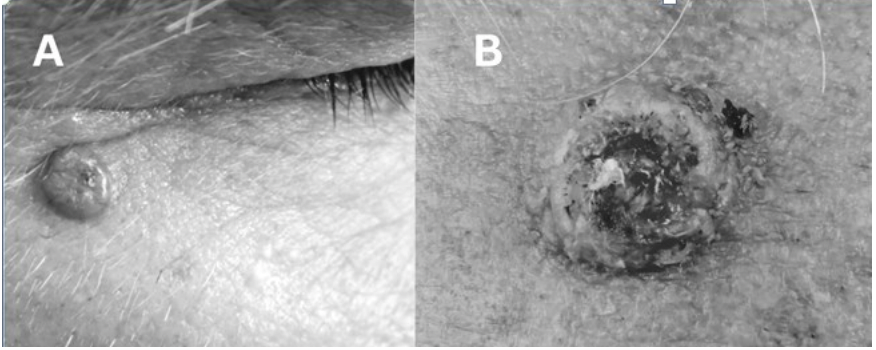
Basal Cell Carcinoma (BCC) (Image A)
- What is it: BCC is the most common type of skin cancer (about 75% of all cases). It’s a cancer of the keratinocytes (a type of skin cell) that begins in the deepest layer of the epidermis, which is the outermost part of the skin. It is associated with long-term sun exposure and typically happens on areas like the head, neck, and arms. It’s rare for BCC to spread to distant parts of the body. However, it may spread to and damage nearby nerves or deeper skin layers.
- Appearance: BCC most commonly looks like a flesh-colored circular growth: picture a waxy, pearl-like bump on top of the skin.
- Prevention: Avoid long-term sun exposure, wear protective clothing (e.g., hat, sunglasses, long sleeves), and use sunscreen year-round (SPF 30 or more). See a health care worker if you notice changes in your skin.
- Treatment: Treatment can involve surgery or radiation therapy to remove the cancer.
Squamous Cell Carcinoma (SCC) (Image B)
- What is it: SCC is the second most common type of skin cancer and also starts in the epidermis (outermost layer of the skin). Like BCC, SCC is also associated with long-term sun exposure and typically shows up on sun-exposed areas like the head, neck, and arms and rarely spreads to other parts of the body. It can also show up in the mucous membranes (inner linings of your organs), including in your mouth and stomach. Other risk factors for SCC include immunosuppression (examples: untreated HIV, being on steroid drugs, cancer therapy, or having received an organ donation) and chronic wounds that don’t heal.
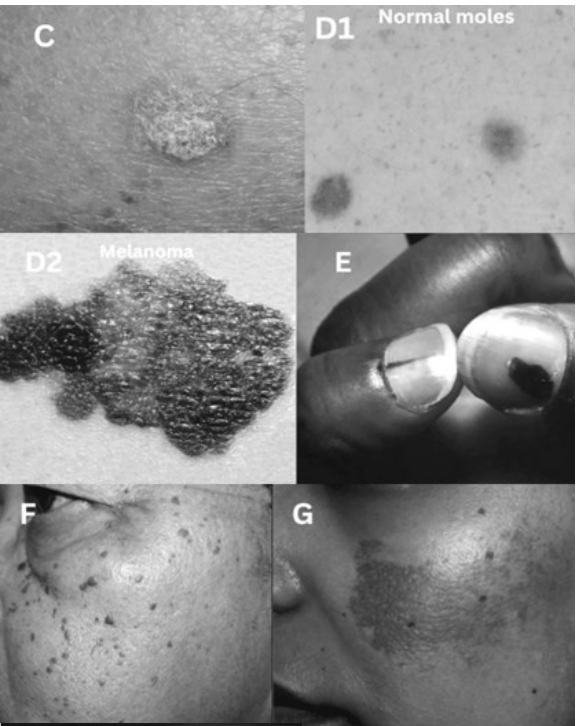
- Appearance: Two common ways SCC appears are a red, scaly patch or a red, firm bump. It is also important to note that SCC can start from a “precursor lesion,” or a small area of skin damage that eventually becomes cancerous. These pre-SCC marks are called actinic keratosis
(Image C) and are also caused by sun exposure. They appear as small, rough, red/brown or white elevated spots. Not all of these marks will develop into a squamous cell carcinoma. Additionally, SCC can show up on your lips as a pale, dry, and cracked area or in your mouth as white or pale spots. - Prevention: While not all actinic keratoses develop into SCC, if you think you may have one, try to get it checked out by a healthcare provider to get treatment before it becomes a cancer. As with all skin cancer prevention, avoid long-term sun exposure, wear protective clothing, and use sunscreen year-round (SPF 30 or more). Quitting smoking and avoiding exposure to chemicals without proper personal protective equipment can also help prevent SCC.
- Treatment: Treatment can involve surgery or radiation therapy to remove the cancer.
Melanoma (Image D2)
- What is it: Melanoma is a cancer of the cells that make melanin, the pigment that gives skin its color. Melanoma commonly starts on skin that gets the most intense sun exposure, such as the face, arms, and legs. However, it can form on any part of your body, including the eyes, nose,
and throat. Melanoma is the most dangerous type of skin cancer because it develops quickly, spreading to other organs. - Appearance: The first signs and symptoms of melanoma often involve changes in an existing mole (30% of cases) or a strange-looking new growth on the skin (the majority of cases). While not all moles are cancer, it is important to check them regularly and note any changes. It’s good to know your ABCDEs to decide if a normal mole may have potentially become cancerous melanoma: asymmetric mole (one half doesn’t match the other), borders (edges) that are irregular, colors vary within the mole, diameter (width) is large (more than 6
millimeters across), and the mole is evolving (changing) in
color, shape, or size. - Specific types of melanoma:
- Acral lentiginous melanoma: Occurs on the palms of the hands,
soles of the feet, or underneath the nail beds. This type of melanoma is more common in people with darker skin tones. - Subungual melanoma (Image E): Specifically refers to melanoma that develops underneath the fingernails and toenails.
- Acral lentiginous melanoma: Occurs on the palms of the hands,
- Prevention: Avoid the sun in the middle of the day, wear protective clothing, wear sunscreen year-round (SPF 30 or more), avoid tanning, and become familiar with your skin so you notice any changes or new moles. Because melanoma develops and spreads so quickly, it’s important to see a health care provider as soon as possible if you notice any signs or symptoms.
- Treatment: Depending on the spread of the melanoma, treatment can involve a skin biopsy (tissue sample) for testing, surgery to remove the cancer, and/or radiation therapy or drugs.
Skin Conditions and People of Color (POC)
Research studies have found that POC more often suffer from skin conditions that are less common in white people. We are sharing information about a few of these conditions because they may cause worries about skin cancer, but are not actually dangerous. Some common, non-cancerous skin conditions in POC include dermatosis papulosa nigra (DPN), melasma, and pseudofolliculitis barbae
(PFB). DPN (Image F) are dark brown, solid, raised spots typically on the face and neck that show up when you are a teenager and do not cause symptoms (e.g., they do not scale or crust). Melasma (Image G) appears as an area of patchy skin discoloration on the face that is worsened by sun exposure and pregnancy. It may resolve on its own, respond to treatment (examples: lightening creams or steroid drugs), or last for many years. PFB (Image H) is a chronic form of “razor bumps” that can occur wherever you shave (face, groin, etc.) and especially affects those with curly or coarse hair. It can be treated by stopping shaving or using a topical corticosteroid cream, gel, or lotion.