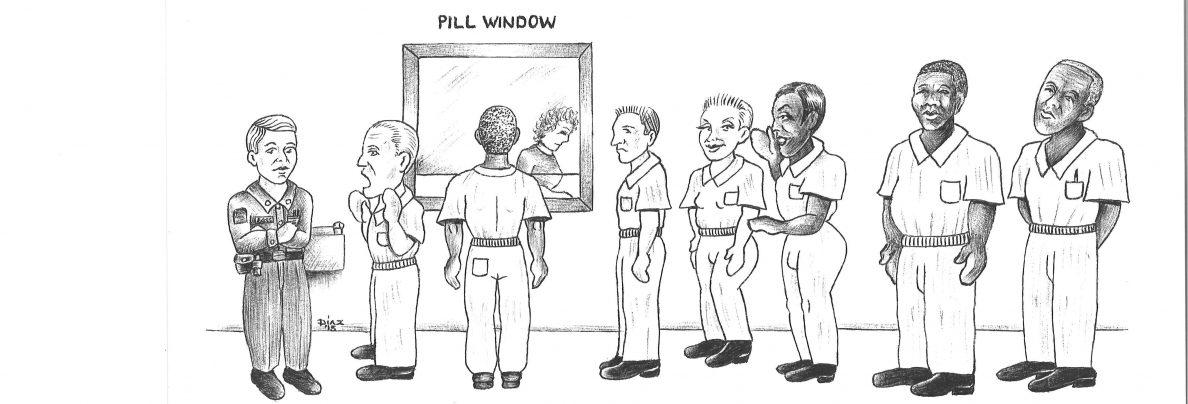
PRISON IS NOT MENOPAUSE FRIENDLY: Be Prepared to Self Advocate

By Kwaneta Harris

From PHN Issue 58, Fall 2024

What Are Menopause and Perimenopause?

Menopause = Meno (monthly period) + Pause (stop). Menopause is
the end of having a menstrual cycle. Technically, it is twelve months without
having a menstrual period. Perimenopause leads to menopause. It is when a person with ovaries is in their final reproductive years. Symptoms of menopause can begin during perimenopause and continue for up to a decade. Despite the name, the journey to menopause is not just about our period stopping. Some people don’t have periods due to a hysterectomy or infertility. It’s easier to think of menopause as a time of reduced hormone production.

Continue reading “PRISON IS NOT MENOPAUSE FRIENDLY: Be Prepared to Self Advocate”

HOW TO FIGHT FOR YOUR RIGHTS TO ADEQUATE HEALTHCARE IN PRISON

By Leo Cardez

From PHN Issue 57, Summer 2024

Months later, I still remember the way the nurse looked at me when I described my recent weight gain, hair loss, and depression. It was clear she either wasn’t listening or didn’t believe me—or, more likely, simply didn’t care. Almost two years later, I was diagnosed with overactive thyroid, but not before months of fighting for treatment. The struggle inspired me to train to become an Illinois Department of Public Health certified healthcare peer educator. As a peer educator, I speak to newly incarcerated people during
their onboarding orientation about specific health risks in prison. I also explain their options when they are dissatisfied with the level of their healthcare and treatment.

Communication issues between prison healthcare workers and people in custody aren’t new; quite the opposite. As a peer educator, I’ve noticed “not feeling heard” is a common refrain among my community. They feel dismissed. My old cellmate Liam McCauley has been suffering from severe eye issues for almost a decade. He told me, “It’s ridiculous to the point of being absurd. I’m suffering every day. My mother is a healthcare worker and I’ve consulted outside literature about my symptoms. Everything points toward a serious disease, and I need to see a specialist. But being referred and then given an appointment to see a specialist is its own gauntlet.” I’m no doctor, but his bright red, bloodshot eyes and constant struggles to see make it pretty clear. The eye drops they keep giving him aren’t doing enough. So he presses on with homemade solutions, hot water compresses and the like, hoping something will help ease the pain. He’s not the exception.

Continue reading “HOW TO FIGHT FOR YOUR RIGHTS TO ADEQUATE HEALTHCARE IN PRISON”

OVERCOMING HOPELESSNESS: A MENTAL HEALTH DISPATCH

By JD Frandsen

From PHN Issue 57, Summer 2024

I know your shade of blue. I existed for 13 years in a maximum-security facility, a bleak, lifeless place with no trees, no humanity, and no hope. I am now at a minimum camp, and any petty infraction could send me back to that awful place where old homies have died and the suicide wind blows like devils screaming. Anxiety is my constant companion. But this day, my friends, I implore you all never to give up.

Continue reading “OVERCOMING HOPELESSNESS: A MENTAL HEALTH DISPATCH”

I’VE FALLEN AND I CAN’T GET UP! HOW TO MAINTAIN GOOD BALANCE AND FLEXIBILITY

By Troy Glover

From PHN Issue 56, Spring 2024

Prisoners perceive time differently in prison. In our imagination, that pecan tree in our backyard is still full, green, and vibrant. Those polyester butterfly-collared shirts I own are still in style. For prisoners, time seems to stand still.

Because many of us are serving long sentences, it is imperative that we try to maintain optimum health. The best way to do this is through proper nutrition and exercise. Many prisoners only focus on endurance and strength training. As we grow older, we need to incorporate another facet to that regime of wellness: balance and flexibility.

Continue reading “I’VE FALLEN AND I CAN’T GET UP! HOW TO MAINTAIN GOOD BALANCE AND FLEXIBILITY”

GET BUSY! COMBATTING THE HEALTH RISKS OF A TEXAS SOLITARY CELL

By Kwaneta Harris

From PHN Issue 56, Spring 2024

At 51, living in a solitary confinement cell in Texas increases my likelihood of an early death. It’s a daily fight to remain physically and emotionally healthy. I’ve been incarcerated 17 years, with seven and a half in the hole. Texas is known for its brutal prison conditions: No air conditioning. No ability for anyone to purchase individualized TVs. A two-page commissary list for everyone. Although, on paper, we are allowed out of our cell daily for a shower and outdoor/indoor recreation, that’s seldom enforced. I developed a regimented daily routine. As a Black woman, I know I’m at risk for diabetes, obesity, hypertension, and stroke. As a former nurse, I know how to combat the harm this box was designed to do.

Continue reading “GET BUSY! COMBATTING THE HEALTH RISKS OF A TEXAS SOLITARY CELL”

FIVE BASIC TIPS FOR GOOD HEALTH AND SKIN WHILE INCARCERATED

By Jamila Harris

From PHN Issue 56, Spring 2024

I know how difficult it is to maintain certain beauty standards as a woman incarcerated. I was once incarcerated and missed the certain regalness that came with the privileges of being a lady, such as pedicures and manicures, having a stylist do my hair, and seeing a dermatologist or esthetician for skin care. Who doesn’t miss a jazzercise or yoga session or an afternoon at a
massage parlor with close friends? Incarceration takes away many of these privileges. However, there are basic tips and best practices that can still be exercised anywhere for good health and skin. I am sharing some of these basic tips, and although we cannot buy nail polish, makeup, and most of our hair products from the commissary, these tips will still help to maintain the beauty
in you.

Continue reading “FIVE BASIC TIPS FOR GOOD HEALTH AND SKIN WHILE INCARCERATED”

Ask PHN: Types of Sexually Transmitted Diseases and Testing

By M. Ali
From PHN Issue 55, Winter 2024

Dear Prison Health News,
If you would be so kind (if you haven’t already done so), please explain the variety of sexually transmitted diseases such as trichomoniasis, herpes I vs. II, etc.

— Anonymous

Dear Anonymous,
Thank you for this great topic suggestion. Sexually transmitted diseases (STDs), which develop due to sexually transmitted infections (STIs), are very common, impact people of all genders, and can result from any type of sexual activity (vaginal, anal, oral, etc.). STIs can be caused by viruses, bacteria, fungi, or parasites. STDs don’t always cause symptoms or may only cause mild symptoms, so it’s important to get tested if you believe you may have been exposed. The good news is STDs are preventable, and most are treatable as well. Talking to your partner about STDs and how to stay safe while having sex is an important way of protecting your health. Prevention is always better than treatment.

Continue reading “Ask PHN: Types of Sexually Transmitted Diseases and Testing”

COVID-19 Update: RISING CASES AND UPDATED VACCINES

By Lily HA
From PHN Issue 55, Winter 2024

As of October 2023, there has been another surge in COVID-19 cases. Since data reporting to the Centers for Disease Control (CDC) is more limited than it was earlier in the pandemic, it’s harder to know the size of the surge. Still, cases, hospitalizations, and deaths have all increased since summer. When possible, wearing a mask, keeping physical distance between yourself and others, and getting tested if you feel sick or are around someone else who tests positive continue to be good ways to protect yourself and others.

New variants of the coronavirus continue to arise, as experts have expected. There are currently multiple sub-variants of the Omicron variant going around. So far, these new variants and sub-variants seem to have similar symptoms to and cause similarly severe disease as previous variants, although they are more transmissible (easier to get and pass on to other people).

Continue reading “COVID-19 Update: RISING CASES AND UPDATED VACCINES”

Holistic Corner: HERBAL REMEDIES

Adapted by Hannah Calvelli
From PHN Issue 55, Winter 2024

A variety of herbs and plants may grow in prison courtyards. In preparation for Spring, we highlight a few of the holistic remedies featured in The Prisoner’s Herbal, a book by Nicole Rose. We acknowledge that not everyone may have access to courtyards, but we hope this information can be useful for some and interesting to many. Furthermore, while the herbs in this article may have medicinal properties, research and evidence on how well herbal medicines work is limited. We recommend that you speak with a medical professional to address any symptoms you are experiencing.

Continue reading “Holistic Corner: HERBAL REMEDIES”

TYPE 1 DIABETES EXPERT

By Sterling Allan
From PHN Issue 55, Winter 2024

Note from PHN editors: This article is specifically about managing type 1 diabetes, which is an autoimmune problem usually diagnosed in childhood or early adulthood. The author has a lot of experience managing his sugars. What works for him might not work for everyone.

Here in prison, I was able to maintain my A1C in the “normal” range for four years, despite how difficult it is. My purpose here is to share some key takeaways I’ve learned the hard way, so you can benefit from my pioneering efforts without the difficulties.

First, let me say that I no longer target a “normal” blood sugar average, which is 100 mg/dL on the glucometer. My motivation has come from what my doctor told me when I was first diagnosed as a type 1 diabetic two decades ago. He said I could live a full life if I maintained good control of my blood sugar.

Continue reading “TYPE 1 DIABETES EXPERT”