
By Leo Cardez
From PHN Issue 57, Summer 2024
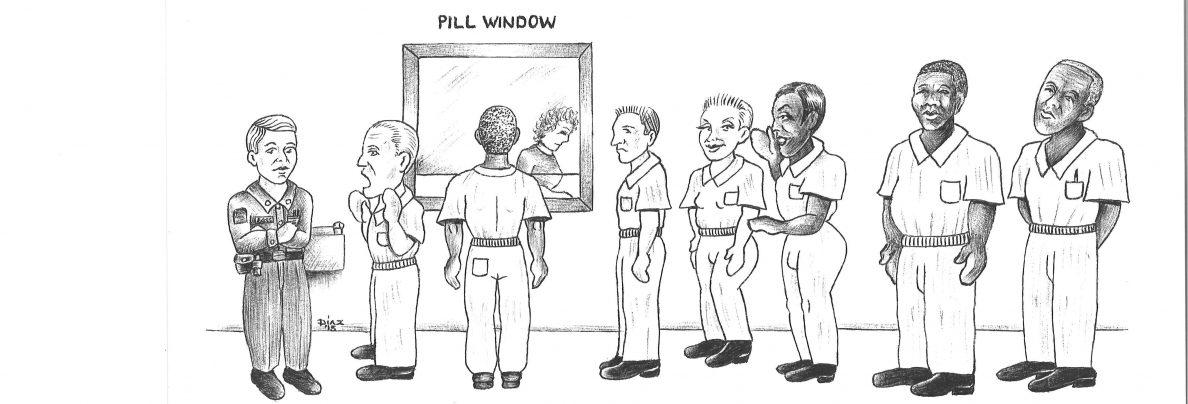
Months later, I still remember the way the nurse looked at me when I described my recent weight gain, hair loss, and depression. It was clear she either wasn’t listening or didn’t believe me—or, more likely, simply didn’t care. Almost two years later, I was diagnosed with overactive thyroid, but not before months of fighting for treatment. The struggle inspired me to train to become an Illinois Department of Public Health certified healthcare peer educator. As a peer educator, I speak to newly incarcerated people during
their onboarding orientation about specific health risks in prison. I also explain their options when they are dissatisfied with the level of their healthcare and treatment.
Communication issues between prison healthcare workers and people in custody aren’t new; quite the opposite. As a peer educator, I’ve noticed “not feeling heard” is a common refrain among my community. They feel dismissed. My old cellmate Liam McCauley has been suffering from severe eye issues for almost a decade. He told me, “It’s ridiculous to the point of being absurd. I’m suffering every day. My mother is a healthcare worker and I’ve consulted outside literature about my symptoms. Everything points toward a serious disease, and I need to see a specialist. But being referred and then given an appointment to see a specialist is its own gauntlet.” I’m no doctor, but his bright red, bloodshot eyes and constant struggles to see make it pretty clear. The eye drops they keep giving him aren’t doing enough. So he presses on with homemade solutions, hot water compresses and the like, hoping something will help ease the pain. He’s not the exception.
Joshua Wilson notes a litany of back problems going back several years: pinched nerve, slipped disk, sciatica, etc. “If I had a dollar for every time the nurses and docs in prison have blown me off or told me there wasn’t anything to be done, I’d be Bezos rich,” Wilson explains. “That’s not even the worst part. The worst part is when they eyeball you up and down as if they had X-ray vision and then determine that you look okay and should just take a couple of aspirin and drink more water.” Like many who suffer from chronic issues in prison, he often feels overlooked and ignored.
That type of blatant disregard for our pain—our humanity—isn’t just frustrating, it often leads to misdiagnosis, delayed care, and permanent, avoidable damage. This is what I tell my class to do if they believe they aren’t getting the most from their interactions with the prison health professionals:
- Prepare for your appointment by creating and practicing a one-minute summary of your symptoms, including:
- What was going on when you first noticed the issue?
- How long have you been feeling the symptoms?
- Does anything make the issue worse or better? Rate the pain on a scale of 1 to 10.
- Don’t just say, “Oh, my stomach hurts.” Be specific in your choice of words, like jabbing or stinging, to describe your symptoms.
- Ask questions that require a response, and have a pen and paper handy to write down the responses. Then, wait silently until they are answered. For example:
- What are some potential diagnoses for my issue?
- Will I have to see a specialist?
- Have you dealt with something similar in the past, and if so, what was the result?
- Is this something that will require medication, and if so, for how long? Is it curable?
- Are there future symptoms I should look out for?
- When will I be called in to see or hear my test results?
- Can you explain that in simpler terms?
- Can you please repeat that?
- Can you give me more details or send me an informational printout about the illness/disease?
- Never give up: If your doctor or nurse isn’t answering your questions to
your satisfaction, try asking them again in a direct manner. For example:
- I see we may have a disconnect. Please understand, this is my health we’re talking about, and I need you to address my concerns before I leave today.
- I’m worried and in pain. I need to know more about what is happening to me.
- I get that you’re swamped, but I’m not comfortable that you understand my condition.
- What can we do to avoid me having to put in a complaint or grievance? I would prefer not to have to go that route, and I imagine that you feel the same way.
- Speak up: You’ve done everything I’ve recommended to no avail; it’s time to
follow through.
- File an emergency grievance using your notes to fill out specific days, times, and people involved.
- If you have an outside network, ask them to call the facility and ask to speak to the head warden, healthcare supervisor, and doctor. Ask them to send emails to create a paper trail.
- Write well-written letters to the wardens, healthcare supervisors, and their bosses or state or national ombudsman offices to spark action.
- Ask for a new doctor, a second opinion, or a specialist consultation. Remember, you have a right to adequate healthcare, and only you can insist on your needs being met.

