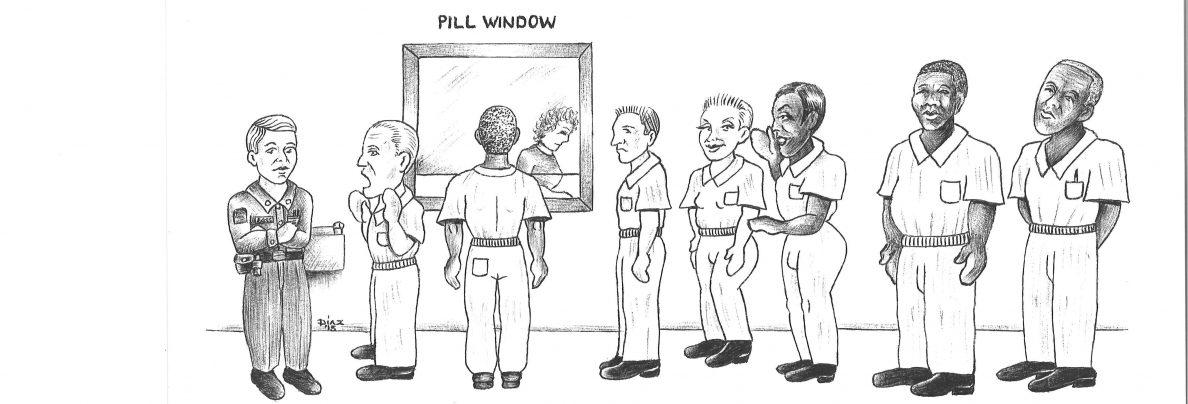
Mental Health is Essential

By Ethan Macks

From PHN Issue 46, Spring/Summer 2021

With all the concern going around about COVID-19 and what is essential and what is not, I feel that there needs to be greater consideration for mental health.

Being incarcerated, I see a lot of stigma concerning the issue of mental health. Being labeled as SMI (Seriously Mentally Ill) on the streets, I’ve had ample experience with mental health and how it should be treated. The National Institute of Mental Health defines SMI as a “mental, behavioral, or emotional disorder resulting in serious functional impairment, which substantially interferes with or limits one or more major life activities.” SMI commonly refers to a diagnosis of psychotic disorders (schizophrenia and schizoaffective disorder), bipolar disorder, major depressive disorder with psychotic symptoms, treatment-resistant depression, anxiety disorders, eating disorders, and personality disorders.

Continue reading

My Experience with PTSD

By Bernard Lee Starks Jr.

From PHN Issue 43, Summer 2020

Hi, my name is Bernard Lee Starks Jr. I am a 30-year-old African-American male who has suffered from post-traumatic stress disorder (PTSD). Contrary to the belief that PTSD only happens in people who have experienced war, my PTSD comes from getting sucker-punched over an intense three-year span in a juvenile correctional facility. The degree to which I was affected was unknown until I became an advocate against sexual violence and began reading about rape trauma syndrome.

Being in confinement is very difficult, especially while fighting symptoms of PTSD. It’s always noise from people or machinery which adds difficulty to maintaining assertiveness. After speaking with a trusted psychologist at 20 years old, I was told I likely had PTSD.

Continue reading

Promoting Mental Wellness in the Time of Coronavirus

By Rosa Friedman

From PHN Issue 42, Spring 2020

Being locked up is difficult enough under normal circumstances, and right now circumstances are far from normal. You may be experiencing a wide range of emotions, like loneliness due to lack of contact with peers and visits from loved ones, helplessness and anger at not being able to protect yourself, or numbness at the unrelenting nature of this crisis. You might shift dramatically between moods with little
warning, or have more thoughts about or symptoms related to other traumatic experiences. Whatever you’re feeling, remember there’s no wrong way to react to what’s happening. It’s normal to feel ungrounded, helpless, or just “off” in such an unusual situation, one where there’s so much uncertainty and powerlessness. It’s also normal to feel extra calm, especially if you’ve been through a lot of crises before. What’s important is to focus on what’s within your control and to do what you can to
care for yourself, mentally as well as physically. Here are some ways to practice selfcare during this difficult time:

Continue reading

Complex PTSD

By Lucy Gleysteen and Brittany Mitchell

From PHN Issue 41, Winter 2020

What is complex trauma, or complex PTSD?

Complex trauma is a trauma that is repetitive, occurs over a period of time, and is frequently interpersonal in nature. Complex PTSD most often develops in childhood and can include experiences of abandonment at an early age, physical abuse or neglect, sexual abuse, emotional abuse, living in a neighborhood that has high levels of violence, being impacted by war, repetitive and invasive medical procedures, or other experiences of being in a traumatic environment for a prolonged period of time. Not everyone who has had traumatic experiences develops complex PTSD. However, those who do might experience certain difficulties that can be painful to live with.

Continue reading

Giving is Living

By Leo Cardez

From PHN Issue 40, Summer/Fall 2019

“Only a life lived for others is a life worthwhile.” —Albert Einstein

“Life’s most persistent and urgent question is, ‘What are you doing for others?’” —Rev. Dr. Martin Luther King, Jr.

Could the secret to a better life be as easy as helping others? The published scientific research is compelling:

Continue reading