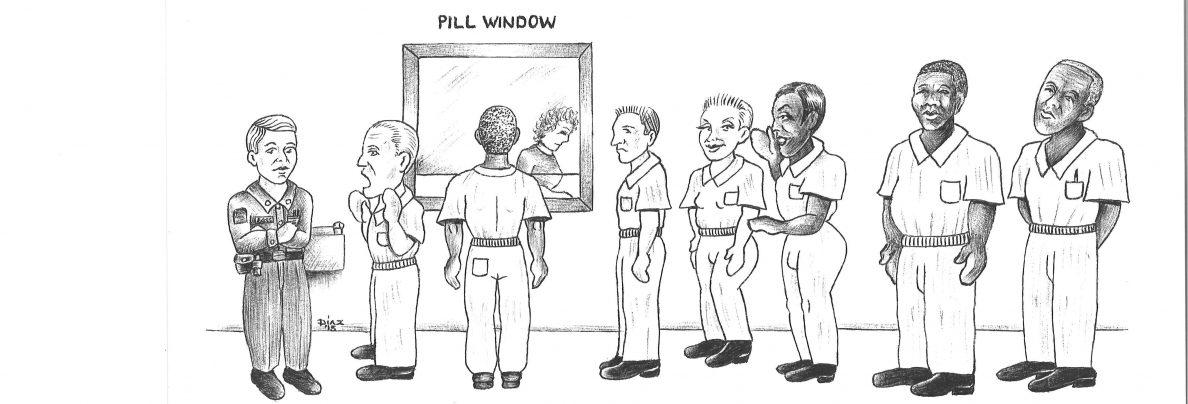

COVID Prison Testimonies: Zhi Kai Vanderford in Minnesota, April 2020

April 5, 2020
Zhi Kai Vanderford
Minnesota Correctional Facility, Shakopee

I am a trans male, been on testosterone about a year here. I am a Minnesota lifer that they sent out of state for 14 years in California, 12 years in Oklahoma, and the rest of the time broken up in Minnesota, so a total of 33 years.

The inmates here are fortunate—we have each been issued a mask and told we will get a new one monthly. But out of all the staff, and they are coming in [from the outside world], I have only ever seen one wear a mask—a foreigner—a nurse, bless his heart. The rest of these jackholes are ignorant young folks that feel fine—of course they do. They are asymptomatic.

Of course, what is the excuse of the 2 old geezer doctors that I saw? They don’t care about our health. They joke it is inmate population control.

And the inmates I spoke with are saving their masks for when they are needed. When people are actually dying. But there are Minnesota prisons that have it [COVID].

Thank you for keeping me in the loop and being a lifeline. If I get more time, I will draw or write. Feel free to print my work. Just give me credit. Maybe I can get things improved here.

Stay safe.

Zhi Kai

COVID Prison Testimonies: Rudy Vandenborre in Florida, September 2020

A Donkey’s Rock
By Rudy Vandenborre
Everglades Correctional Institution
September 12, 2020

When I went to Washington, D.C. from a small farmer’s town in Belgium, it felt like I entered a whole new unknown world. As a butterfly who morphed, fluttering its wings for the first time, I believed that I was invincible by living a very dangerous lifestyle. “Whatever happens to other people ain’t going to happen to me,” became my motto.

The first time I encountered an unseen enemy was when I took a guy home who insisted on us wearing condoms. AIDS was running rampant all around the world—every country, every city became a hot-zone. However, the mainstream media stayed mum on this HIV pandemic, as it was still branded a gay disease.

There is a saying that even a donkey will not stumble over the same rock twice! So, why did I?

Continue reading “COVID Prison Testimonies: Rudy Vandenborre in Florida, September 2020”

Against the Odds

By Antwann Johnson

From PHN Issue 47, Fall 2021

My name is Antwann Johnson, and I felt compelled to share my experience with COVID-19 while incarcerated. On October 16, 2020, I was working as a DLA (Daily Living Assistant) and I was approached by the Housing Unit FUM (Functional Unit Manager). He asked me if I would be willing to live in the Medical TCU for the purpose of giving assistance to the medical personnel who cared for inmates that had contracted COVID-19 and were severely ill and dying.

At first, I felt reluctant because this virus was still a mystery to us all. Not long after that conversation with the FUM, I was informed that my cousin and two of my close friends had tested positive for COVID-19. After that, I made the decision to go to the TCU Unit. I’ve seen firsthand how many of the inmate patients don’t have any family or people who care about their well-being. The primary purpose of being selected to live in the medical unit was to help prevent any cross-contamination or spread of the virus as much as possible. It would be two inmate patients that I grew close to while they were battling COVID-19 who would ultimately give me the strength to continue fighting this worthy cause.

Continue reading

COVID-19 and Vaccination Update

By Lily H-A

From PHN Issue 46, Spring/Summer 2021

On February 27, 2021, the Food and Drug Administration (FDA) approved a third COVID-19 vaccine, developed by Johnson & Johnson (J&J, sometimes called “Janssen”) under the same shortened process as the other two currently approved vaccines (Pfizer-BioNTech and Moderna).

The J&J vaccine only requires one dose instead of two, and doesn’t need ultra-cold refrigeration, so it’s easier to distribute. It also uses slightly different technology from Pfizer and Moderna’s vaccines. All three vaccines work by making the cells in your body produce harmless proteins that look like parts of the coronavirus, which teaches your immune system how to recognize and destroy the actual coronavirus if it enters your body. Pfizer and Moderna’s vaccines use a messenger called mRNA to do this, while J&J’s uses a deactivated virus called an adenovirus. This deactivated virus cannot infect you, and is not the same as the coronavirus.

Continue reading

How Other Health Conditions Interact with COVID-19 (Coronavirus)

By Lily H-A

From PHN Issue 44, Fall 2020

Researchers have found that there are certain factors, including having other health conditions, that make it more likely you will have a severe illness if you catch COVID-19.

Here are some of the factors that seem to go along with more complications from COVID-19. Of course, having these health conditions doesn’t guarantee you’ll definitely get severely ill if you catch COVID-19. And people who are otherwise healthy can still get very ill if they catch COVID-19. The best way to prevent getting severe complications from COVID-19 is to not get it at all, so it’s important to keep practicing social distancing when possible, wearing a face covering, and practicing hand hygiene.

Some of these you can do more about than others. For the ones you can do something about, we’ve included some tips. Eating healthy, being physically active, and quitting smoking can improve or lower your risk of a lot of these health conditions. If you take medications, take them regularly and make sure you have enough refills.

Continue reading

Promoting Mental Wellness in the Time of Coronavirus

By Rosa Friedman

From PHN Issue 42, Spring 2020

Being locked up is difficult enough under normal circumstances, and right now circumstances are far from normal. You may be experiencing a wide range of emotions, like loneliness due to lack of contact with peers and visits from loved ones, helplessness and anger at not being able to protect yourself, or numbness at the unrelenting nature of this crisis. You might shift dramatically between moods with little
warning, or have more thoughts about or symptoms related to other traumatic experiences. Whatever you’re feeling, remember there’s no wrong way to react to what’s happening. It’s normal to feel ungrounded, helpless, or just “off” in such an unusual situation, one where there’s so much uncertainty and powerlessness. It’s also normal to feel extra calm, especially if you’ve been through a lot of crises before. What’s important is to focus on what’s within your control and to do what you can to
care for yourself, mentally as well as physically. Here are some ways to practice selfcare during this difficult time:

Continue reading

If You’re Having Symptoms of COVID-19

By Suzy Subways

From PHN Issue 42, Spring 2020

Most people with COVID-19 have no symptoms, or their symptoms are mild. But some have:

  • Cough
  • Fever
  • Tiredness
  • Shortness of breath
  • Difficulty breathing, in severe cases

In an article for Prison Legal News, Michael D. Cohen, M.D., explains that people in prison who are over 50 may be at higher risk for severe symptoms. There is currently no vaccine or cure for COVID-19. Scientists have started testing some possible medicines, but they don’t know if these will work yet. It’s important to ignore rumors and just get health information from reliable sources like the Centers for Disease Control and Prevention (CDC) and World Health Organization.

Continue reading

How to Protect Yourself and Others from COVID-19

By Lorin Jackson and Frankie Snow

From PHN Issue 42, Spring 2020

Handwashing

Handwashing can help prevent the spread of COVID-19. Here are some tips for handwashing:

  • Wash your hands with soap and water for at least 20 seconds.
  • Make sure you rub all hand surfaces with soap, including thumbs, fingertips, and backs of hands.
  • Dry with a paper towel if possible, and use that to turn the water off.
  • Always wash your hands before and after eating, and after coughing, sneezing, blowing your nose, or being in a crowded area.
  • If soap and water are not available, use hand sanitizer that contains 70% alcohol or more.
  • It is believed that the virus enters the body through the eyes, nose, or mouth. Avoid touching your eyes, nose, and mouth with unwashed hands.
Continue reading

What’s Up with COVID-19?: Here’s the Scoop

By Lorin Jackson and Frankie Snow

From PHN Issue 42, Spring 2020

As of April 30:

  • There are more than 3.25 million cases confirmed worldwide, with roughly a million incidents of recovery from the disease, and almost a quarter million have died.
  • In the United States, there are about a million cases, with almost 130,000 recovered and more than 60,000 deaths.
  • The United States has more recorded deaths than any other country. One possible reason is that there is not a coordinated national or regional effort to test people and track cases to contain outbreaks.
  • Congregate settings, such as nursing homes, detention centers, prisons/jails, and homeless shelters are extremely vulnerable to massive outbreaks of COVID-19 and account for some of the spikes in cases. This is because it is difficult to properly quarantine and maintain physical distancing in these settings.
  • As of mid-April 2020 in New York City, the NYC Department of Correction said that 369 inmates tested positive out of more than 3,900 in custody at Rikers Island and smaller facilities.
  • As of April 29, more than 70% of people incarcerated in federal prisons who have been tested for COVID-19 had the virus.
  • Chicago’s Cook County Jail is one of the largest and most impacted jails. More than 800 people had tested positive by April 28, and it had one of the highest infection rates in the country. In April, activists held a two-day emergency bailout where more than 130 people were able to leave the jail.
Continue reading

What is COVID-19?

By Monet Davis and Lorin Jackson

From PHN Issue 42, Spring 2020

All information adapted from the Centers for Disease Control and Prevention at CDC.gov and the World Health Organization at who.int.

Defining COVID-19

The coronavirus disease 2019 is a disease caused by a virus that was discovered in the Wuhan province of China in February 2019. It is abbreviated as COVID-19 and often referred to as the “coronavirus,” “corona,” or “the ‘rona.” In COVID-19, the ‘CO’ stands for ‘corona,’ ‘VI’ for ‘virus,’ and ‘D’ for disease. The 19 is for the year 2019.

Continue reading