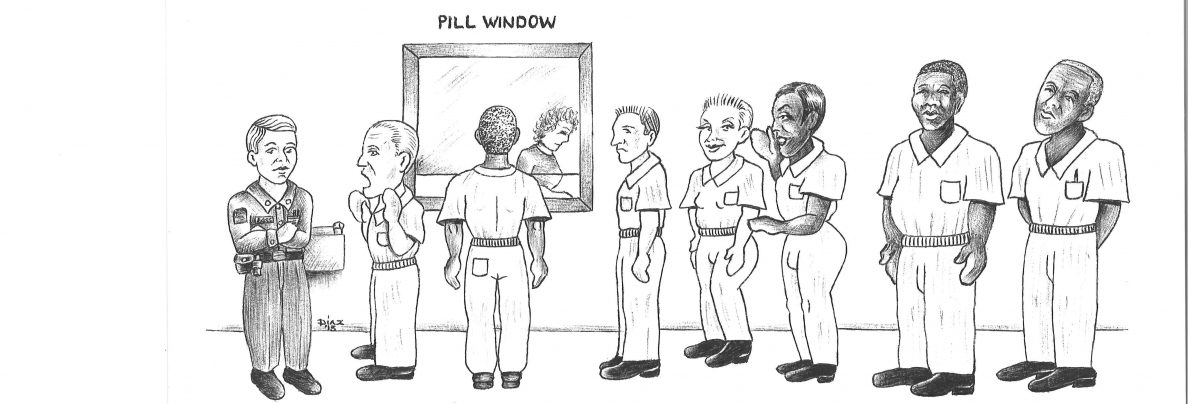
Free the Elders, Improve Public Health

by Laura Whitehorn

From PHN Issue 19, Winter 2014

Mohaman Koti is either 85 or 87 years old, depending on whether you go by his birth certificate or what his mother told him when he was a child. He has been incarcerated in New York State since 1978—long enough that his sentencing transcript has been lost in the system.

Mr. Koti has been hospitalized multiple times for health problems, including myasthenia gravis (a neurological disorder) and cancer. He must often use a wheelchair, and his hearing is pretty much shot.

In May, Mr. Koti appeared before the parole board for the sixth time, and was again denied release. The board said they thought he might commit another crime if released—despite testimony from prison staff calling him a reliable peacemaker. Continue reading “Free the Elders, Improve Public Health” →

There’s No Shame in Love

by Jose de Marco

From PHN Issue 19, Winter 2014

I’m Jose de Marco. My father was Latino, my mother was African-American. I’m a man that loves other men.

   I believe if people were more accepting of who they are, they would not care when other people criticize them about who they love. But you have to get to the point where outside influences—whether it’s church, your teacher, your mother, or your brother—your happiness cannot depend on the permission of other people. Continue reading “There’s No Shame in Love” →

Open Letter to Activists on the Outside

by Sergio Hyland

From PHN Issue 18, Fall 2013

I’m not one of those people who accept the notion that the existence of prisons is inevitable, because if I accept that, I’ll have to accept other associated notions as fact. Like the notion that the thousands of inhumane solitary confinement torture chambers across the nation have to exist. Because I’m on the inside and see the reality of these places, I definitely can’t accept the notion that prisons keep our communities safe! Continue reading “Open Letter to Activists on the Outside” →

Fasting for Rights and Dignity: From Guantanamo Bay to California

by Suzy Subways

From PHN Issue 18, Fall 2013

From Gandhi’s independence movement in India to women demanding the right to vote, from Cesar Chavez to Irish Republican Army political prisoners, oppressed people have used hunger strikes to show their deep commitment to freedom. This year, two major hunger strikes shook U.S. prisons. Continue reading “Fasting for Rights and Dignity: From Guantanamo Bay to California” →

Prison SMART: Using Breath to Manage Stress  

by Jeanine Campbell          

From PHN Issue 18, Fall 2013

   Prison Stress Management and Rehabilitation Training (Prison SMART) is a simple program that teaches a breathing technique designed to reduce stress, heal past trauma, and provide ways to handle negative emotions such as anger, guilt, and frustration. Started by the International Association for Human Values (IAHV), Prison SMART is active in prisons in over 36 countries and in 30 state, county, and federal correctional institutions across the U.S. The program is also adapted for correctional staff, the formerly incarcerated, and people in halfway houses, on parole or probation, and in juvenile justice programs. Continue reading →

Prison Yoga

by Jeanine Campbell

From PHN Issue 17, Summer 2013

The Prison Yoga Project is an organization based in California that seeks to establish yoga and mindfulness meditation programs in prisons and rehabilitation centers across the United States. They give trainings for yoga instructors interested in starting yoga programs in prisons, and have established over 20 prison yoga programs in correctional facilities across the country. Continue reading “Prison Yoga” →

Rising Above HIV Discrimination

By Joel Laux, M.C.C.F. Montgomery County, PA

From PHN Issue 16, Spring 2013

I am HIV Positive, and have been so for about eleven years now. I also am an IV Drug user. I have had personal experiences involving discriminatory practices in the law or its application. Although I have not been actually prosecuted in a court of law for an HIV specific criminal statute, I have been threatened with it. Continue reading “Rising Above HIV Discrimination” →

Decarceration: A New Strategy Against Prisons

by Dan Berger

From PHN Issue 16, Spring 2013

We are at the beginning of a new movement against the prison. It works to shrink the prison system by using radical critique, direct action, and practical goals for reducing the reach of imprisonment. I would like to call this a strategy of decarceration. It is the demand to close prisons and reduce policing—but also to open schools and build communities. It is a strategy that takes advantage of political conditions without sacrificing its political vision. Continue reading “Decarceration: A New Strategy Against Prisons” →

Passing the Torch: John Bell 1946-2012

By Laura McTighe

From PHN Issue 15, Winter 2013

In September 2012, the Prison Health News community lost John Horace Bell, AIDS activist, mentor to a generation of currently and formerly incarcerated people, co-founder of PHN, and our friend. We know that many of you reading this article have not met John, but you do know him through his work and his continued influence on all of us at PHN. Those of you with internet access may want to read one of the many testimonials in his honor: http://fight.org/about-fight/fights-history/john-bell/. For the rest of you, we wanted to share a few PHN-specific memories. Continue reading “Passing the Torch: John Bell 1946-2012” →

Interview with Joshua Glenn of Youth Art & Self-Empowerment Project (YASP)

By Naseem Bazargan

From PHN Issue 15, Winter 2013

What is YASP all about?

   We are a youth-led organization working to repeal the laws that allow young people to be tried as adults [in Pennsylvania]. The current law is if you are tried for anything that can be considered a violent crime, you will automatically be charged as an adult, and you will be held in an adult prison pretrial.Before 1996, you could only be automatically charged as an adult for murder, and all other cases the DA had to petition to get you charged as an adult. [Act 33] made it so that the crimes you could be charged for varies; it could be anything considered violent, and the DA has the discretion on what’s violent and what’s not. We don’t think young people should be charged as adults at all. We want them to repeal the amendment so it could be like it was before 1996. We have facts that show that since 1996, charging young people as adults, it never reduced crime. Continue reading “Interview with Joshua Glenn of Youth Art & Self-Empowerment Project (YASP)” →