Presentation

by Fatima Malika Shabazz

From PHN Issue 24, Spring 2015

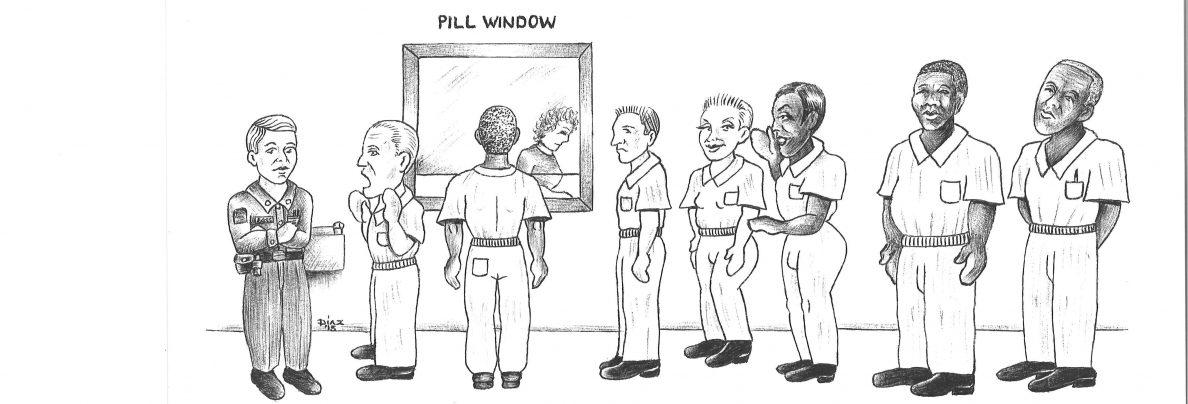
   My name is Fatima Malika Shabazz. I am an African American transwoman currently incarcerated in the gulags of California. It is great that we can get feminizing hormone treatments in the system now. But there is still the problem of presentation. That is, being able to present every day as a woman, beyond the breast growth that comes along with being on hormones. Continue reading “Presentation”

Truly Understanding the Connection between HIV and Incarceration

By Laura McTighe

From PHN Issue 24, Spring 2015

   We know that HIV and incarceration overlap. One in seven people with HIV will pass through our prisons and jails this year. But knowing that HIV and incarceration overlap doesn’t tell us why. Understanding why is critical if we are to end AIDS. Continue reading “Truly Understanding the Connection between HIV and Incarceration”

PTSD: The Enemy Within

By S. Muhammad Hyland
From PHN Issue 23, Winter 2015

Post-traumatic stress disorder (PTSD), an anxiety disorder that can arise after an actual or threatened death or serious injury to self or others, too often goes undiagnosed. Formerly known as shell shock syndrome, PTSD was once considered to plague only soldiers. Today, statistics tell a different story.

Neighborhood Violence

Denizens of inner cities across America also suffer from this dangerous disorder but routinely go unnoticed. If PTSD can be successfully used to defend violent criminal behavior perpetrated by current or former troops, it should work that same way for inner-city minorities. Both groups of people are subject to the same feelings created by their respective environments. Continue reading “PTSD: The Enemy Within”

Dining Hall Boycott at Pennsylvania’s Coal Township Prison

by Incarcerated Citizens Coalition

From PHN Issue 22, Fall 2014

From June 16 to 23, men at State Correctional Institution (SCI) Coal Township in Pennsylvania initiated a 1-week, peaceful boycott of the Inmate Dining Hall in response to the implementation of the Department of Corrections’ (DOC) “efficiency diet” at the prison. The men supported one another by sharing food and commissary items on the units. The boycott was overwhelmingly successful on the West Side of the prison, where over 70% of the men participated, with only 20 to 25 individuals per unit/wing going down to the dining hall per meal. Continue reading “Dining Hall Boycott at Pennsylvania’s Coal Township Prison”

Is There Any Help for My OCD?

By Dean Stone

From PHN Issue 21, Summer 2014

If I had one nickel for every time I heard of someone here in prison having some odd behaviors or being labeled OCD, I’d be able to afford that crack team of lawyers who would get me out of here. But recent articles and books indicate that a great deal of progress in treating OCD can occur even without intensive psychotherapy or medication. People in prison have the opportunity to use the four-step treatment method outlined by Dr. Jeffrey Schwartz in his book, Brain Lock: Free Yourself from Obsessive-Compulsive Behavior. Continue reading “Is There Any Help for My OCD?”

Ending the Spectrum of Violence Against Women: The Positive Women’s Network

By Teresa Sullivan

From PHN Issue 21, Summer 2014

“We, as women living with HIV, envision a life free from violence, coercion, and discrimination for all people. We, as women living with HIV, demand an end to the many different forms of violence faced by all women, including physical, emotional, psychological, religious, sexual, institutional, and economic violence, and the trauma that violence leaves in its wake.” —Positive Women’s Network, USA

When we hear the word “violence,” the first thing we visualize is the physical abuse of someone. And women living with HIV are indeed vulnerable to physical violence because of stigma and ignorance. This reality was made brutally clear yet again a few weeks ago with the heartbreaking murder of Elisha Henson, who was killed in Texas because of her HIV status. A survey conducted by the Positive Women’s Network, USA (PWN-USA) last year found that 72% of women living with HIV who responded were survivors of intimate partner violence. However, for PWN-USA, ending violence against women includes ending a spectrum of human rights violations, including but not limited to physical violence, that women have faced for many generations throughout history. Continue reading “Ending the Spectrum of Violence Against Women: The Positive Women’s Network”

The Lasting Impact of Brain Injury

by Drew Nagele, MJ Schmidt, and Monica Vaccaro
From PHN Issue 21, Summer 2014

Each year, there are 2.5 million new traumatic brain injuries in the United States. In fact, it is estimated that 13.5 million people—or 4.5% of the population—are living with some type of acquired brain injury.
The number of people who are living with a brain injury in prisons is far greater than we would expect, and most of these injuries were never diagnosed or treated. Recent research suggests that about 60% of people in prison have had an acquired brain injury sometime in their life, most often prior to becoming incarcerated. This is important, because the problems that result from a brain injury make almost all aspects of life harder. Brain injury can make a person more likely to make poor decisions, increasing their risk for getting in trouble with the law and decreasing their likelihood of being successful in everyday life. The effects of brain injuries also can make it harder for a person to succeed in prison education programs or to meet parole conditions.

Continue reading “The Lasting Impact of Brain Injury”

Long-term Pain and Medical Neglect

by Chasity Williams

Edited by Warren Lane

From PHN Issue 21, Summer 2014

   I am writing to you because your newsletter has inspired me, and I’m hoping that you might submit my story. I’m currently at SCI Muncy in Pennsylvania and have been for two years for violating pre-release by leaving a DOC (Department of Corrections) halfway house (due to being sexually harassed by a staff member). Since I’ve been back at SCI Muncy, I’ve been fighting the medical department for proper treatment for chronic pain. I suffer from degenerative disc disease and severe sciatica from a work injury. I’ve been disabled since May of 2005, receiving benefits for my child and myself through the federal government. My main issue is pain relief and pain management, and I’ve been denied that here. I do want everyone to know that I became addicted to the drug called Oxycodone. However, that was ten years ago and I am no longer that person. Continue reading “Long-term Pain and Medical Neglect”

Free the Elders, Improve Public Health

by Laura Whitehorn

From PHN Issue 19, Winter 2014

Mohaman Koti is either 85 or 87 years old, depending on whether you go by his birth certificate or what his mother told him when he was a child. He has been incarcerated in New York State since 1978—long enough that his sentencing transcript has been lost in the system.

Mr. Koti has been hospitalized multiple times for health problems, including myasthenia gravis (a neurological disorder) and cancer. He must often use a wheelchair, and his hearing is pretty much shot.

In May, Mr. Koti appeared before the parole board for the sixth time, and was again denied release. The board said they thought he might commit another crime if released—despite testimony from prison staff calling him a reliable peacemaker. Continue reading “Free the Elders, Improve Public Health”

There’s No Shame in Love

by Jose de Marco

From PHN Issue 19, Winter 2014

I’m Jose de Marco. My father was Latino, my mother was African-American. I’m a man that loves other men.

   I believe if people were more accepting of who they are, they would not care when other people criticize them about who they love. But you have to get to the point where outside influences—whether it’s church, your teacher, your mother, or your brother—your happiness cannot depend on the permission of other people. Continue reading “There’s No Shame in Love”