What To Know About MONKEYPOX

By Olivia Duffield
From PHN Issue 50, Summer/Fall 2022

You may have heard recently about an outbreak of a virus called “monkeypox” in the United States and elsewhere. As of July 2022, there have been over 3,000 recorded cases of monkeypox in the U.S. It was declared an international public health emergency by the World Health Organization on July 23, and, at this time, there have now been a few cases identified in prisons throughout the U.S.

Continue reading “What To Know About MONKEYPOX”

The “BIG THREE” and Depression

By Ethan Macks
From PHN Issue 50, Summer/Fall 2022

Do you ever feel like you just don’t want to wake up and face the day? Do you feel unmotivated and restless? In small amounts, this is normal for most people, but if you find yourself experiencing this almost every day coupled with self-defeating thoughts and a feeling that overall things are just not worthwhile, you may be seeing the early signs of something I am all too familiar with. Depression is widespread in prison, and you may be thinking to yourself, “What is there to look forward to in the penitentiary?” Unfortunately, that is exactly the problem. Prison breeds emotions like anger, sadness, and despair. On top of all the negativity that goes on, there are countless reminders of what’s going on in the outside world. Some people handle these feelings better than others, but I believe that most of you who are reading this can relate. I feel that with the right tools, you can recognize a low mood and remedy this issue before you fall into a very dark place. An isolated mind is your own worst enemy.

Continue reading “The “BIG THREE” and Depression”

A Tool in the Struggle to End Medical Copays

By PHN Editors
From PHN Issue 50, Summer/Fall 2022

Activists in Pennsylvania have started a coalition to end the $5 copay for medical care in state prisons. The coalition includes FAMM, the Pennsylvania Prison Society, the Coalition to Abolish Death By Incarceration (CADBI), the Institutional Law Project, and Physicians for Criminal Justice Reform—and now Prison Health News has joined too. For those in prison in Pennsylvania, you can help! We need to show the DOC that the copays are truly a hardship for incarcerated people and their families. To do that, you can start using the grievance process when you are unable to afford a copay. The DOC tracks grievances, so seeing grievances over copays will help them understand how often people in prison can’t pay. If you’re not in Pennsylvania, you can do this too, but there is more power in numbers where there is a group of activists taking action together.

Continue reading “A Tool in the Struggle to End Medical Copays”

COVID-19 Updates: JULY 2022

By Lily H-A
From PHN Issue 50, Summer/Fall 2022

Omicron and BA.5

The current version of the coronavirus that is infecting the most people in the U.S. is called BA.5. This is a “sub-variant” of the omicron variant. It is the most contagious version of the virus yet, and it’s sometimes able to get past antibodies from prior infections and vaccination. However, these antibodies do still provide some protection from BA.5, especially against severe illness and death. BA.5 does not seem to cause more severe disease than other variants. Data are also beginning to suggest that long COVID may be somewhat less common for people after being infected with omicron sub-variants than with earlier variants.

Continue reading “COVID-19 Updates: JULY 2022”

An Open Letter to the Incarcerated of Pennsylvania

By Anonymous
June 16, 2022

It has been more than a year since the Pennsylvania Department of Corrections vaccinated its inmate population. Mask mandates have been lifted. The unvaccinated have been allowed off quarantine and spread throughout general population. And yet here we are, another year gone, and the pandemic restrictions limiting activity and quality of life within the prisons remain. The PADOC has successfully used a deadly pandemic as a smoke screen to institute many of the wide-ranging and destructive restrictions it’s wanted all along.

Many of us served as “essential” workers during the pandemic, tirelessly disinfecting the blocks, preparing food and distributing trays. We toiled for long hours to keep the prisons running, with the understanding that Covid was an unprecedented situation that required all of us to work together. Besides those few lucky enough to work, the majority of us were stuck confined in our cells for days and weeks and months on end. It was tough on all of us, but we made it through, and to show its appreciation for our cooperation the PADOC has chosen to keep its pandemic restrictions in place indefinitely.

Continue reading “An Open Letter to the Incarcerated of Pennsylvania”

Prison Decarceration in the Context of the COVID-19 Pandemic  

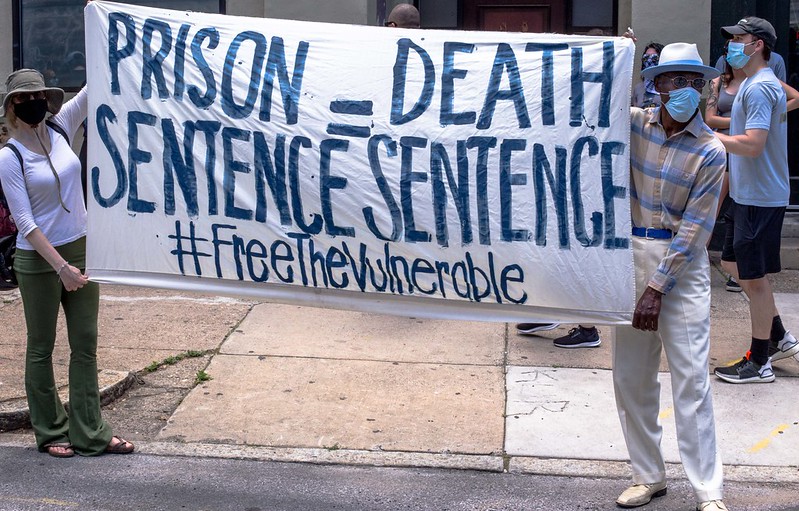
Protesters in Philadelphia demand decarceration during the COVID-19 pandemic. Photo by Joe Piette, shared under Creative Commons https://creativecommons.org/licenses/by-nc-sa/2.0/

by Yosef Robele

Editor’s note: With this thoroughly researched academic article, Prison Health News has the rare privilege of offering scientific data—in addition to our continuing testimonies from people in prison—about how the COVID-19 pandemic has impacted incarcerated people. We agree with the author, Yosef Robele, that decarceration is the winning strategy we all must fight for.  

Yosef is a 2nd year masters student in the Environmental Health Science & Policy Track at George Washington University School of Public Health. He was born and raised in Denver, Colorado. He went to undergrad at the University of Pennsylvania, where he majored in Environmental Science and minored in Physics. He hopes to have a career tackling environmental justice issues from a scientifically informed background.

Abstract

The COVID-19 pandemic has done much to reveal structural inequalities in American society. Throughout the pandemic, the Prison Industrial Complex has been shown to be wholly inadequate in protecting incarcerated persons, prison staff and the surrounding communities. As both the incarcerated persons and the staffs have higher rates of chronic disease than the general population (Wildeman & Wang, 2017), this places them at higher risk of an adverse outcome from contracting COVID-19. While the prison population has actually decreased by about 10% for various reasons during the pandemic, (Franco-Paredes et al., 2021) prison reform advocates have called for more radical slashes. This paper will advocate not only for these radical slashes but also for other forms of support for formerly incarcerated people. Over summer 2020 alone, over 500,000 cases of COVID-19 can be attributed to the carceral state (Hooks & Sawyer, 2020). In order to prevent further cases and deaths, it’s imperative that incarcerated people are not only released but released with enough health care and housing to support themselves during the pandemic.

Continue reading Prison Decarceration in the Context of the COVID-19 Pandemic  

Prison Health News Advisory Board Member Under Threat for Health Activism in Oregon Prison

April 28, 2022

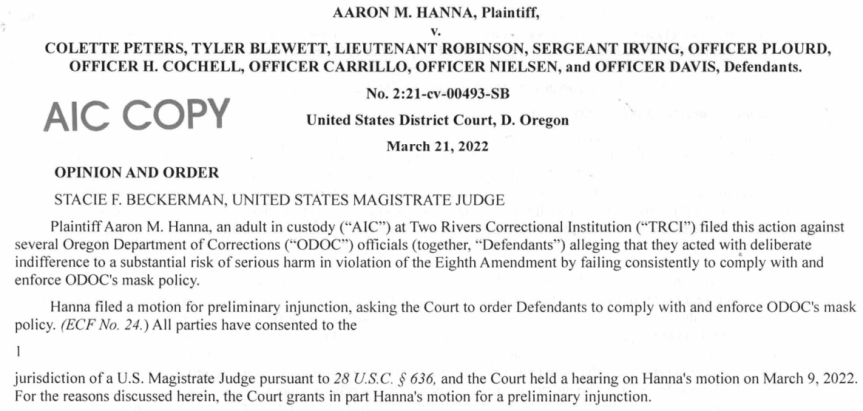
One of our beloved Advisory Board members for Prison Health News, Aaron Maxwell Hanna, filed a lawsuit last year against the Oregon Department of Corrections for not enforcing its own rule that prison employees must wear a face mask to protect those inside the prisons from COVID-19. It’s widely known that prison guards are the most common way COVID gets into prisons from the community. After filing the lawsuit, Max got COVID earlier this year. At his facility, Two Rivers Correctional Institution, 1,287 others have contracted COVID; across the state, 45 people in prison have died of it.

Due to his tireless advocacy, Max won a preliminary injunction on March 21 in federal court that requires the prison authorities to enforce their own mandate for staff to wear face masks. After Max won the injunction, guards allegedly pressured a gang member to take Max’s life, but Max was able to use the support he has from other prisoners to reach this gang member, who is now testifying for Max. We are awaiting the next court hearing, which will be May 10 and cover the alleged retaliation by prison guards against Max and others.

Max requested that we share this note from him on our website, along with a copy of the preliminary injunction:

I am fighting the good fight and standing up against an entire prison staffed with right-wing Republicans who don’t care about me or anyone serving a sentence behind these walls. You have no idea how big, how red and bright this target is on my back, but I don’t care because I am doing the right thing for everyone! This is what matters to me, and how I want to be remembered.

With what I am writing to you, I hope to encourage all of you who are prison activists, who want to protect the lives of those that can’t or won’t stand up for themselves. Please keep all of us in your thoughts and prayers. If you want to email me with words of encouragement, please do so at: MaxwellH7019@gmail.com and I’ll get those from you. I’ll even respond to you if you let me know that you want me to do so.

Stay strong, brothers and sisters!
Max

You can read the preliminary injunction here: https://prisonhealth.news/wp-content/uploads/2022/04/max-hanna-mask-injunction-2022.pdf

Medical neglect of elders: Ivan Schweitzer in Pennsylvania

July and November, 2021
Ivan Schweitzer
incarcerated in Pennsylvania

To whoever can help,

I would like to know if I can sue Wellpath or the prison for medical negligence. If so, how and can you find me a lawyer? I have been waiting for 2 years to get my teeth fixed. Meanwhile, a couple months ago 2 teeth broke off and I lost a filling. I have put in sick calls but no response. I have ended up with infected lymph nodes. They gave me antibiotics and said I would get X-rays. 15 days later, no word from dental. With the lymph nodes, I got double and blurred vision. Continue reading “Medical neglect of elders: Ivan Schweitzer in Pennsylvania”

COVID Prison Testimonies: Laderic McDonald in Missouri, August 2020

August 31, 2020
Laderic McDonald
Potosi Correctional Center, Missouri

This is Laderic McDonald and I am writing you to ask you to advocate on the behalf of me and other offenders at PCC.

We currently do not have any Dial soap or any anti-bacterial soap at canteen when we placed our Ad-Seg canteen orders. We are only allowed 2 bars per month per policy, so if you attempted to order Dial soap, you may not have gotten any soap at all. How can we keep our hands clean? How can we sanitize our cells? They do not allow us to clean our cells, a Big Health Hazard! We have no soap and COVID-19 is still pummeling America. Please call Potosi Deputy Warden of Ops, Jody Glore and advocate on our behalf. Tell him we need to be afforded access to cleaning/hygiene supplies that will keep us CORONA FREE.

Guards are not wearing a mask in Ad-Seg. They have to feed us, escort us to medical, showers, rec cages, phones and etc, but they are not wearing a mask, and they cannot practice social distancing.

It would be nice if they released offenders with no conduct violations out of Ad-Seg so we can take care of ourselves. Ad-Seg is unsafe and has offenders at risk for COVID-19. Not a good situation!

Please do something. We need your help.

With all due respect,

Laderic

Editor’s note: Ad-Seg is a term for solitary confinement. Prison Health News did respond to this letter when we received it, and we sent some information about how to advocate for oneself using grievances, lawsuits and other means.

Inhumane Conditions

An Excerpt from Felon: The New Slur Word by Justin Guyton
Chapter 7: Inhumane Conditions

            One of the issues that prisoners face in maintaining their health is the inadequate medical treatment that is given to prisoners. We all know that medical treatment isn’t cheap, but just because a person is incarcerated doesn’t mean that they don’t have the right to adequate care. The nursing staff and the majority of the doctors suggest the same remedy for pretty much any health issue a prisoner may face: “Take these ibuprofen, drink lots of water, and get some rest.” They know that this one-size-fits-all approach doesn’t solve most problems that are brought to their attention, but this is one of the many tactics that are used in an attempt to save money at the expense of the prisoners’ health. These same individuals who took an oath to provide adequate care to those that they encounter are doing the exact opposite. Depending on the illness, this type of ploy can often result in tragedy.

            Some years back, I had a friend that for the point of this story I won’t reveal his name out of respect for his family. This friend was serving a three-year sentence that he’d almost completed. As a means of escape in addition to staying in shape he would work out regularly.

            I’d ended up being moved to another housing unit due to the dormitory that I was previously in was being used to house prisoners whom were lacking their GED. Though no longer in the same dorm, my friend and I would cross paths regularly. A few weeks after I was moved, my friend tragically passed away at twenty-three years old.

Continue reading “Inhumane Conditions”