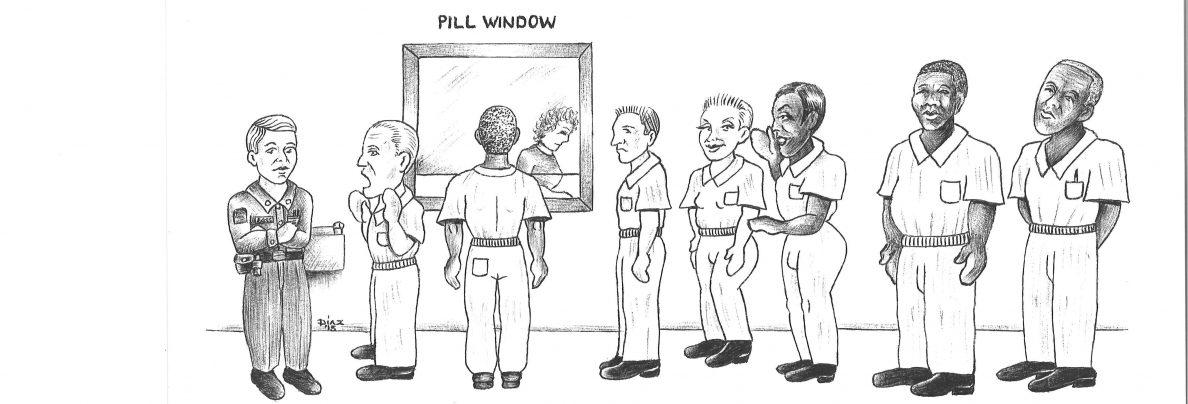
Top Five Tips for a Healthy Mouth

By Leo Cardez
From PHN Issue 54, Fall 2023

As I look around my inmate community, I see too many of us with rotting teeth. Some of that is due to genetics and age, and some of it is due to lack of real dental care and professional cleanings, but it is mostly because of our own lack of dental hygiene and care. Most of us should already know the basic dental care. Therefore, I am only going to cover a few tips:

Continue reading “Top Five Tips for a Healthy Mouth”

The End of the Covid Public Health Emergency: NEW APPROACHES TO AN ONGOING PANDEMIC

By Kirby Sokolow
From PHN Issue 54, Fall 2023

On May 5, 2023, the World Health Organization (WHO) announced that the COVID-19 pandemic “no longer constitutes a public health emergency of international concern (PHEIC).” Days later, the U.S.’s federal public health emergency (PHE) also ended.

These announcements left the world wondering: What does it mean to end a public health emergency? Do the two declarations mean the same thing? Is COVID finally “over”?

Continue reading “The End of the Covid Public Health Emergency: NEW APPROACHES TO AN ONGOING PANDEMIC”

Scabies: THE ANTI-LOVE BUG

By Anonymous
From PHN Issue 54, Fall 2023

Scabies is sadly a fairly common occurrence in the crowded conditions of prisons. Prison officials will state cleanliness or hygiene, but transmission of scabies usually occurs through direct and prolonged skin-to-skin contact, as may occur among family members or sexual partners. Casual skin contact is unlikely to result in transmission.

Scabies is the infestation of the skin by the mite Sarcoptes scabiei var. hominis. Scabies infestations result in intense itching, most notably at night, with wavy and slightly scaly lines from 2 mm to 1.5 cm in length that end in dark bumps where the mite may be visible. Prisoners with dark skin tones may find it harder to detect scabies infestations. Burrows may not be easily visible if the individual has been scratching the area. Classically, scabies affects the spaces between fingers, flexural areas of the wrist or elbow, and folds of skin on the buttocks and beltline.

Continue reading “Scabies: THE ANTI-LOVE BUG”

Breast Reconstruction Victory

By Lori McLuckie
From PHN Issue 54, Fall 2023

Dear Prison Health News,

Thank you very much for your letter in response to my inquiry about breast reconstruction after mastectomy.

Since I wrote that letter to you, a minor miracle has occurred: The Colorado Department of Corrections has made the decision to provide coverage for my reconstruction process. This decision was made in April 2022. Since then, I have had a consultation with the plastic surgeon, I’ve had the first surgery to install the expanders (the surgery occurred on Sept. 12, 2022), and I’ve begun the expansion process.

Continue reading “Breast Reconstruction Victory”

Cancer Screening for Transgender and Gender-Diverse People

By Lily H-A
From PHN Issue 54, Fall 2023

The goal of cancer screening is to catch cancer early, when it is more treatable and curable. Some cancer screenings, like colonoscopies, are recommended for everybody once they reach a certain age. However, other types of screening, like prostate screening and mammograms, have traditionally been recommended based on gender assuming that this matches sex assigned at birth. The medical guidelines for cancer screening do not yet reflect the needs of trans people, and there is also limited data about trans people’s risks for various cancers and how gender-affirming care like hormones and surgeries may affect these risks. As a general rule, University of California San Francisco (UCSF) Transgender Care recommends that people get cancer screenings based on the body parts they have, regardless of gender or hormones.

Continue reading “Cancer Screening for Transgender and Gender-Diverse People”

Ask PHN: Hippa in Prison

By Jamila Harris
From PHN Issue 54, Fall 2023

Dear PHN,
Could you explain the rules and violations of the HIPAA Act? Is it a violation if the correctional officer stays in the room while we are seeing medical staff and knows my medical information?

– L.W.

Dear L.W.,
When it comes to the rights of incarcerated individuals and the privacy of their medical information, a valid concern always comes to mind. “Do the correctional officers have the right to know your medical information?” A person who is incarcerated has certain legal rights under the Health Insurance Portability and Accountability Act, also known as HIPAA. This act is a federal law passed in 1996 that protects how medical information of individuals—including identifying factors such as address, birthdate, and social security number—is transferred and disclosed to others. Under the law, this identifiable health information is known as “protected health information.”

Continue reading “Ask PHN: Hippa in Prison”

Incarcerated by Cancer

By Shawn Harris
From PHN Issue 53, Summer 2023

“There is a list of 132 inmates diagnosed with cancer,” announced the psychologist assigned to my block. She was sitting in front of her computer as the Psychology Department head and I discussed the commencement of the first-ever Cancer Support Group at my prison. I had for the past year been stressing the importance of having a cancer support group at my facility. We were having a meeting to finalize the date and time when the group would start. We weren’t certain if there were even enough inmates diagnosed in the prison to warrant a support group. In fact, the Psychology Department head specifically asked me how many inmates I knew were currently battling the illness. He even struggled to recall one or two he remembered working with in recent days. So, when the psychologist said the number, we were all stunned.

Continue reading “Incarcerated by Cancer”

Ask PHN: HEMORRHOIDS

By M. Ali
From PHN Issue 53, Summer 2023

Dear Prison Health News,
I was wondering if you could do an article on the topic of hemorrhoids. Some points of interest might be:
What causes hemorrhoids?
Is bleeding a common occurrence?
What are the treatments for them?

Sincerely, Pete B.

Dear Pete B.,

What are hemorrhoids?
Hemorrhoids are swollen veins that can develop inside the rectum and around the anus. There are two types of hemorrhoids: external hemorrhoids, which occur beneath the skin around the anus, and internal hemorrhoids, which occur inside the rectum. The symptoms depend on the type of hemorrhoid.

Continue reading “Ask PHN: HEMORRHOIDS”

Recognizing LONG COVID

By Kirby Sokolow
From PHN Issue 53, Summer 2023

Three years have passed since the World Health Organization first declared COVID-19 a pandemic. However, people worldwide continue to suffer from this novel coronavirus’ devastating effects. Among them are an estimated 65 million people with symptoms of Long COVID.

Long COVID—also called post-COVID syndrome or post-acute sequelae of SARS-CoV-2 infection—is when someone keeps having COVID-19 symptoms or gets new symptoms that last weeks, months, or years after they get COVID. Anyone infected with COVID-19 can develop Long COVID, even vaccinated folks and people whose initial symptoms were mild. However, vaccination does lower your risk of both getting COVID and developing long COVID.

Continue reading “Recognizing LONG COVID”

Convict Chronicles: FEELING OFF? You’re Not Alone.

By Leo Cardez
From PHN Issue 53, Summer 2023

I read an article in Men’s Health that really struck me. It wasn’t specifically written for the inmate community, but it should have been. In the piece, Dr. (psychiatrist) Gregory Scott Brown is discussing something called adjustment disorder (AD).

In layman terms, AD is a disproportionate reaction to something stressful in one’s life. AD may make one feel worried, hopeless, or a general sense of unease. Sound familiar? Post-COVID inmate issues are pretty similar across the U.S.: anger over job/program/assignment loss, despair about the difficulty in staying in touch with loved ones, sensitivity over race relations, and general malaise over extended lockdowns brought about by anything from quarantine protocols to staff shortages. In time, all these tiny attacks to your routine and well-being add up.

Continue reading “Convict Chronicles: FEELING OFF? You’re Not Alone.”