Interview with Joshua Glenn of Youth Art & Self-Empowerment Project (YASP)

By Naseem Bazargan

From PHN Issue 15, Winter 2013

What is YASP all about?

   We are a youth-led organization working to repeal the laws that allow young people to be tried as adults [in Pennsylvania]. The current law is if you are tried for anything that can be considered a violent crime, you will automatically be charged as an adult, and you will be held in an adult prison pretrial.Before 1996, you could only be automatically charged as an adult for murder, and all other cases the DA had to petition to get you charged as an adult. [Act 33] made it so that the crimes you could be charged for varies; it could be anything considered violent, and the DA has the discretion on what’s violent and what’s not. We don’t think young people should be charged as adults at all. We want them to repeal the amendment so it could be like it was before 1996. We have facts that show that since 1996, charging young people as adults, it never reduced crime. Continue reading “Interview with Joshua Glenn of Youth Art & Self-Empowerment Project (YASP)”
Birthing Behind Bars: A Campaign for Reproductive Justice in Prisons

by Victoria Law and Tina Reynolds

From PHN Issue 14, Summer 2012

“I never thought of advocating outside of prison. I just wanted to have some semblance of a normal life once I was released,” stated Tina Reynolds, a mother and formerly incarcerated woman. But then she gave birth to her son while in prison for a parole violation:

   “When I went into labor, my water broke. The prison van came to pick me up, I was shackled. Once I was in the van, I was handcuffed. I was taken to the hospital. The handcuffs were taken off, but the shackles weren’t. I walked to the wheelchair that they brought over to me and I sat in the wheelchair with shackles on me. They re-handcuffed me once I was in the wheelchair and took me up to the floor where women had their children. Continue reading “Birthing Behind Bars: A Campaign for Reproductive Justice in Prisons”

NO JUSTICE!: When Sex Work Brands You as a “Sex Offender” in New Orleans

by Deon Haywood and Laura McTighe

From PHN Issue 10, Spring 2011

Since our founding in 1991, Women With A Vision, Inc (WWAV) has been standing with the women of New Orleans, no questions asked. We have been trusted with stories that few others hear. But little could have prepared us for that day when ‘J’ pulled out her photo identification card, which read ‘SEX OFFENDER’ in block orange letters. As she explained how she had gotten picked up during a Mardi Gras round up and charged with a crime against nature, she was filled with anger and pain that marked this as the latest instance in a long history of exploitation. She is only 23 years old, one month clean from an 8 1⁄2 year heroin addiction. The ‘sex offender’ label will remain on her ID until she turns 48. Continue reading “NO JUSTICE!: When Sex Work Brands You as a “Sex Offender” in New Orleans”

Recovery from Injustice: An Interview with Ronnie Stephens

by Suzy Subways

From PHN Issue 10, Spring 2011

Ronnie Stephens is an HIV outreach advocate and consultant in Austin, Texas. He has been HIV positive for 10 years and a worker in AIDS services for 14 years. His life’s work is with people who are at risk for HIV because of homophobia, racism, and imprisonment. “I try to target the population that I was locked up with,” he explains. Stephens has been in drug recovery for ten years and gives it much of the credit for his survival. But to him, recovery from drugs is only part of the picture. Like preventing HIV and staying out of jail, it goes beyond the individual. Communities have to do this work together.

Q: What do you mean by “recovery from injustice”?

A: A lot of people who do AIDS strategy don’t really get the idea of social injustice. When they talk about substance abuse and prison, I say, well, half of these kids got beat up down there. They beat you up, and [the prison guards] say, “Well that’s because of what you are.” So what do you have to offer our clients coming out? These kids have been abused. Some of them have been raped, some of them have no family to go to. What do you do for those individuals who are coming back into society and don’t have any family to turn to? That’s kind of traumatizing. That hurts. Continue reading “Recovery from Injustice: An Interview with Ronnie Stephens”

Think About It…

By John Bell (formerly incarcerated) and Laura McTighe

From PHN Issue 4, August 2004

We teach a class for brothers and sisters with HIV that are just getting out of jail and prison. The class is primarily about dealing with life on the out- side. But we also spend a lot of time talking about the pain people suffered while locked up—especially how frequently people had to choose between getting the care they needed for their health and keeping quiet so that no one in their facility would find out their HIV status.

We are writing this article for those of you who are dealing with this issue on the inside now. We do not have answers for you, but there are some things that we want you to know.

It’s Your Call.

There is no protocol and no correct stance on sharing your health status in jail. It is up to you. In prison, being able to make decisions about when, how and to whom you disclose your status is hard if not impossible. Pretty much anything you can do to take care of yourself breaks your confidentiality as a person living with HIV.

Once people know your status in your facility, there is no getting away from the looks, the stares, the comments like “HIV bitch” or “He’s got that hot shit.” Before you think about getting medical care or telling anyone your status, you need to be able to say, “If you have a problem with me being HIV positive, I sincerely hope you get over it” …and mean it.

Accepting It.

People living with HIV have seen a lot of people pass before them—neighbors that dropped off without a trace, friends they watched get sick, family members they cared for at the end stages.

We know that these memories weigh heavily on you—that every time you think about those people who passed on before you, you feel terrified about your own health, about when you will get sick. And, at the same time, it is these memories and this same fear that make you think about reaching out for help and for medical care.

Your Body.

You have probably heard that HIV weakens the immune system so your body cannot fight off infections on its own. But have you heard that your immune system is very strong, and for a long time it wins out against HIV? On average, it takes 10 years before HIV can run through your immune system enough for you to even start feeling symptoms. And if you take care of yourself, you can make that time even longer.

If You Get Sick.

The most important things you can do are to 1. know your body and 2. keep an eye out for changes in your health. Things to watch for: herpes blisters and cold sores that do not go away, thrush that makes your mouth and throat dry and whitish, or pneumonia that makes you really tired and short of breath. Women should also watch for repeated yeast infections.

There are meds you can take to fight off infections like these, and there are also anti-HIV meds you can take to knock out HIV, so your immune system can get strong again and fight off infections on its own. You should be able to get these meds at your facility.

Confidentiality.

But in prison, it is rarely possible to just go to the clinic, get your meds and keep your health status private. If you go to the medical staff about your HIV, 9 times out of 10 someone else is going to find out. A correctional officer might overhear you talking with the doctor, or there might be a scheduled clinic time for the infectious dis- ease doctor at your facility so all inmates know that is the day for people with HIV, or other inmates might see or hear the meds you take in med lines. Whatever the case, no facility protects your confidentiality 100%.

The Choice.

Whether you decide to seek medical care or refuse it, your life is on the line—from the HIV or from the dis- crimination you face in your facility. This is not an easy or fair choice.

There are many people in prison who have stood up to the abuse that people with HIV face, and are getting medical care. We applaud you for your bravery, and know that you have served as inspirations for people in your facilities who are not open about their HIV.

But there are many more people getting sick behind bars, because they have refused treatment. We stand along side you and offer our support in dealing with this difficult decision.

Your Safety.

Whatever decision you make, please keep yourself safe on the inside. You are too valuable, and there is too much work for you to do when you get out.

If you are too afraid to tell people your health status, don’t. If you are afraid to get medical care because others will find out your status, don’t. If you are going to seek medical care, make sure you have someone you can lean on for support—even if it is someone you write to on the outside. If you are going to seek medical care only if you get sick, start preparing now. It will be even harder to deal with the mental and emotional pain from stigma if your body is also weak.

Health Without Meds.

If you choose to not get medical care while you are locked up, take steps to keep yourself healthy.

Bottom line: if germs cannot get inside your body, they cannot make you sick. Shower regularly, wash your hands before you eat, and keep cuts and scrapes clean.

Also, exercise and stress reduction help to keep your immune system strong. Doing push-up, sit-ups and playing sports will all strengthen your body, plus exercise helps you let out tension. And, while it is hard to really get rid of stress on the inside, if you can find five minutes each day to slow down and take some deep breaths, you will feel the difference.

We Are Here.

We are waiting for you on the outside. There are advocates across the country who will make sure that you get the services that you need, and that you have a community of people who are HIV positive and recently released to help support you. You are not alone.

Cellie Rap

by Brian Lafferty, a formerly incarcerated contributor

From PHN Issue 3, April 2004

A conversation between two inmates: Frank, an old head who has been through the system more times than he chooses to remember, and Luis, a young man doing his first bid. They are cellmates, talking during count time.

Frank: So, you about up, huh? Feel good, right?

Luis: Man, you don’t even know. Get back, see some girls, make some money. Been too long.

Frank: Hear that. You want some coffee? What you doin’ when you out?

Luis: What you mean, what I’m doin’? You know what I’m doin’, man.

Frank: What’s your plan? What you got set for yourself?

Luis: What you talking about?

Frank: You got to plan for this.

Luis: Man, I ain’t fittin’ to stay up in here planning something. I’m out, dog. I’m out.

Frank: Coffee’s ready. You think about that program they was talkin’ up?

Luis: That state thing? Man, now I know you crazy. Damn, this coffee’s hot. Thanks.

Frank: That state thing gonna keep you outta here. You know the street’s gonna bring you back.

Luis: Man, I’m goin’ home, meeting some girls, my man Tony gonna get me a spot, make me some money. Be where I know everyone. All I got is four months and a wakeup. I’m golden.

Frank: Them girls is what got you here in the first place. How you expect to go out slinging for Tony and not bring back a hot urine? You know what happens you do that? Be right back here, drinking packets of coffee and doing pushups.

Luis: I got willpower. I ain’t coming back.

Frank: Man, willpower and a box of x- lax is the same thing. A load of crap. You go where you know everyone, means everyone knows you. And your business. Do that state program, it’s a whole new start. Max out, clean urine, you done.

Luis: Done. After a 30 day blackout. I wanna be out, man. Out. I need some money. Can’t make no money there. You know that.

Frank: What you need all this money for? Do this program, walk off your last 6 months of probation, they hook you up with some schooling, a job. Then, only time I see you will be a visit. Right?

Luis: Right. That does sound good.

Frank: Think about it. It’s your life.

Luis: Yeah. It’s my life.

Getting Out Alive

By Teresa Sullivan

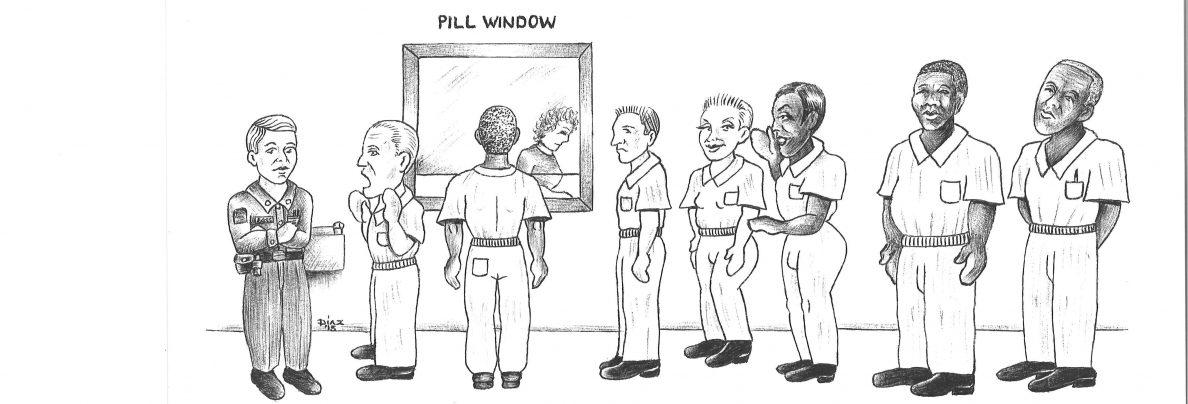
When I went to jail in 2005, one of the biggest problems that I had was at the medication window. One day going to get my HIV medications at the window, I looked at the meds in the cup and they were the wrong meds. There was one too many of the same meds for my HIV medications, and one med I never saw before. This was a big problem because I know that taking the wrong dose of my meds would make me sick – and that med that I never saw before in the cup was not the medication that the doctor ordered for me.

Being told if I did not take the medication in the cup that I would have to go to the hole – that made me very scared, and so I took the medications. Let me say, if I knew what I know today I would have never done that stupid thing, because I got so sick that they had to take me to the ER and I could have died. It is important to know your rights about taking medication while in jail. Today I am an advocate for people that have HIV/AIDS and are in the county jails system. I will never let this happen to someone again while they are in the county jails system. I will always make sure that they know their rights about taking their medications while in jail, and when they are about to come home, I will continue to advocate for their needs.

Continue reading “Getting Out Alive”

Hearts on a Wire

By Najee Gibson

A lot of inmates from the lesbian, gay, bisexual, and transgender (LGBT) community feel lonely because either their families gave up hope for them, or they’re so caught up in the system that they feel like there’s no hope for them when they come out. So they stay back in the same addictive behaviors when they come out, which is not healthy for someone living with HIV.

I did 5 ½ years. I heard about Hearts on a Wire like 2 months before I got released from prison. They were doing an anonymous questionnaire for members of the LGBT community in state facilities: Were you getting health care? How were you being treated? I took the survey and informed them that I was going to be released in April. So they opened their arms and told me to come into the office. That’s how I got plugged in, and from there, things started to blossom. I liked what I heard. All of us need to be understood and cared for, and someone to identify with our hurt. Hearts on a Wire could identify with my hurt, and the bullshit that I put up with being incarcerated, being a person of color – the no-nos, the punishments.

Hearts on a Wire is about 2 years old. We cater to inmates in state facilities in Pennsylvania. We meet every Wednesday, and you pass on what was given to you. We make cards that say, “Keep your head up,” and send them to inmates.

Continue reading “Hearts on a Wire”

“To Help Our People Through This”

Rev. Doris Green on healing communities from the impact of imprisonment and HIV

Reverend Doris Green, founder of Men and Women Prison Ministries and director of community affairs at the AIDS Foundation of Chicago, has been working with prisoners and their families for decades, and fighting AIDS since the epidemic began. She is organizing a coalition of grassroots community organizations to demand access to condoms in the Illinois state prison system. The condom campaign is a policy demand based on the knowledge that good prison health is good community health. “The people on the inside are the people on the outside,” she says. Rev. Green sees her political advocacy as intimately connected with her counseling work with individuals and small groups, rebuilding the community support networks torn apart by mass imprisonment.

Because of mandatory minimum sentences, discriminatory crack possession sentencing, three-strikes laws and other hallmarks of the “war on drugs,” there are now 10 times as many people in prison than there were 20 years ago. People of African descent represent 56% of those imprisoned for drug offenses but only 14% of illicit drug users. “The disparity makes you think nobody’s committing crimes but African Americans and Hispanics,” Rev. Green says. In the past decade, new policies shut ex-prisoners out of public housing, jobs, and social safety net programs. With so many parents, children, spouses and caregivers removed from the community, the emotional, financial and political support systems of entire communities are disrupted.

Continue reading ““To Help Our People Through This””