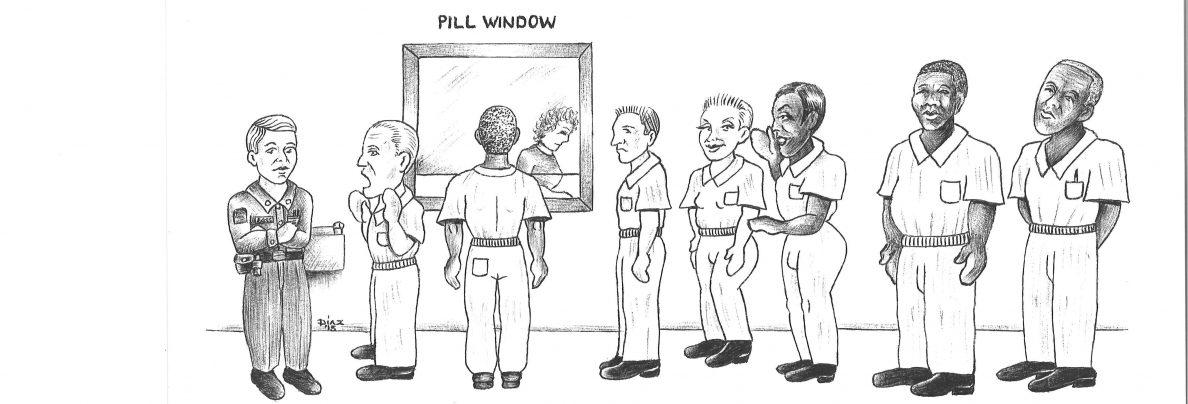
Transgender Housing in Prison

By Fatima Malika Shabazz

From PHN Issue 41, Winter 2020

Hello everyone: Since it’s been so long since I’ve written an article for Prison Health News, it makes sense that I introduce myself. My name is Fatima Malika Shabazz. I am a formerly incarcerated Afican American Transwoman. The last time I wrote anything for Prison Health News, it was due to a civil action I filed against the California Department of Corrections. Since that time, I have been released on parole; I have also been heavily involved in advocacy and activism surrounding either reforming or eliminating bad department of corrections policies related to the trans population.

Continue reading
Complex PTSD

By Lucy Gleysteen and Brittany Mitchell

From PHN Issue 41, Winter 2020

What is complex trauma, or complex PTSD?

Complex trauma is a trauma that is repetitive, occurs over a period of time, and is frequently interpersonal in nature. Complex PTSD most often develops in childhood and can include experiences of abandonment at an early age, physical abuse or neglect, sexual abuse, emotional abuse, living in a neighborhood that has high levels of violence, being impacted by war, repetitive and invasive medical procedures, or other experiences of being in a traumatic environment for a prolonged period of time. Not everyone who has had traumatic experiences develops complex PTSD. However, those who do might experience certain difficulties that can be painful to live with.

Continue reading

Update on Descovy for PrEP and Treatment

By Seth Lamming

From PHN Issue 41, Winter 2020

In October 2019, the Food and Drug Administration approved a new medicine, Descovy, for pre-exposure prophylaxis (PrEP) to prevent HIV. PrEP is a drug regimen that people can take daily or on a particular schedule to prevent getting HIV from sex. PrEP has not been proven to be effective in preventing HIV transmission through needle sharing. Descovy (made up of emtricitabine and tenofovir alafenamide) and Truvada (made up of emtricitabine and tenofovir disoproxil fumarate) are the only two medications that can be used for PrEP. They are both frequently prescribed as treatment options for people who have HIV. Descovy and Truvada are both nucleotide reverse transcriptase inhibitors, which means they stop HIV
DNA from being copied from its RNA blueprints. This stops HIV from replicating. Most people in prisons and jails are not prescribed these meds for PrEP. The “logic” is that people in prisons and jails do not need PrEP because they are not allowed to engage in sexual activities while incarcerated.

Continue reading

Eating Healthy with Diabetes in Prison

By Donna Ballard

From PHN Issue 41, Winter 2020

With me being diabetic and in prison, it’s hard to eat healthy. To eat healthy in prison, you really have to go hungry. They serve us a lot of bread, corn, tortillas, and potatoes. We eat a lot of starches and white food that turns to sugar. We have to learn to eat only half of what they serve. If you eat your
veggies, it’s a start. Some meats.

You get a lot of sodium from commissary food, and starches and fatty foods. There are ways to eat better, but it’s always small portions. Now, if you go to the store, you can get stuff for yourself that will help you. At the store, you get peanuts, energizer mix and M&M’s, mix it together to make a snack mix. You can snack on it all week. Jalapeño peppers, meats—some things are good. Check the labels for contents. I hope my sharing has helped.

Managing Diabetes in Prison

By Timothy Hinkhouse

From PHN Issue 41, Winter 2020

I conducted an interview with my neighbor, J. Parker, who is a man I have known for several years. He is a 51-year-old man who has been diagnosed with diabetes for the past 13 years of his life. He has had lots of things on his plate that he has had to face in his lifetime in addition to diabetes. He has been incarcerated for the past 25 years, and he has an out date of 2023. This makes him worried about how he will take care of his diabetes, eat healthy, and still keep his positive outlook on life. In prison, everything has been taken care of for you. Out in the free world, we have to take care of ourselves, which can be scary for someone getting out after spending over half their life in prison.

Continue reading

Healthy Eating: Non-Diet Hacks and Tips

By Leo Cardez

From PHN Issue 41, Winter 2020

At Prison Health News, we try to avoid talking about diets, in part to be accepting of all body types, and also because changing eating patterns is more healthy than dieting. I’m going to focus on healthy eating tips you can use in almost any prison. Some might work for you, and others might work for other readers, so don’t feel like you need to try them all.

  1. Water is your friend. Drink a cup of water before you walk to chow, another during your meal, and another after. Doing this can fill you up, help with digestion, and help clean your teeth.
  2. Slow down. Eat mindfully. Focus and enjoy the meal. Chew your food at least five times before swallowing. Try eating vegetables and protein first off your tray.
  3. It may help to keep a food journal and write down everything you eat, as long as this doesn’t increase your stress. The idea is that being more aware of everything you’re eating will help you get more control over what you are eating.
  4. Here’s another tip that may work well for some of us but not for others: Create a daily meal and snack schedule to plan what you will eat. Stick to it.
  5. Find a healthy eating buddy to hold each other accountable and for support and encouragement.
  6. Try to eat the opposite of traditional meal portions throughout the day. Have a large breakfast, reasonable lunch, and smaller dinner.
  7. Prepare your cell-made snacks and meals in advance. For example, if you plan to have a snack or meal later that day, set them aside in the morning.
  8. Some people find it helpful to eat all their meals in an 8-to-10-hour window, not eating the other 14 to 16 hours each day. This is often referred to as intermittent fasting. Intermittent fasting, or limiting your eating to certain windows, draws on 20 years of medical research and literature, encompassing a large number of studies, and has been proven to be safe, effective, and highly beneficial. It’s been associated with longer life span, weight loss, maintaining a healthy weight, and may help prevent cancer, heart disease, and Alzheimer’s.
  9. Create small daily goals, and start the day with personal affirmations. For example, “Today, just today, I won’t eat any bread or processed sugar.” Review this every morning and mix it up.
Continue reading “Healthy Eating: Non-Diet Hacks and Tips”

How to Get Your Medical Records

By Timothy Hinkhouse

From PHN Issue 40, Summer/Fall 2019

Being in prison away from our families and friends takes a toll on us, which can lead to unexpected illnesses. We have to navigate our way through the jail/prison health care processes in order for us to get the treatment we need and in a timely manner, so we can live to see another day.

I had wanted to get a copy of my last blood work from my medical file so I can closely monitor my HIV viral load, CD4s, my liver function, etc. When I wrote to our medical department, this is a direct quote of what was written back: “Release of information contained in an inmate’s health record shall occur only when properly requested upon receipt of a fully completed authorization form signed by the inmate. A complete signed CD-28 should also accompany the request. In compliance with the Oregon Revised Statutes (ORS) 192563, the Oregon Department of Corrections will apply charges to each request for health care records. $1.25 for each page for pages 1 through 10, and then $0.25 for each additional page thereafter.”

Continued reading

What is a Latent HIV Reservoir?

From AIDSinfo.net, a program of the US Department of Health and Human Services

From PHN Issue 40, Summer/Fall 2019

Key Points

  • A latent HIV reservoir is a group of immune cells in the body that are infected with HIV but are not actively producing new HIV.
  • Finding ways to target and destroy latent reservoirs is a major challenge facing HIV researchers. Researchers are exploring different strategies for clearing out reservoirs.

What is a latent HIV reservoir?
A latent HIV reservoir is a group of immune cells in the body that are infected with HIV but are not actively producing new HIV. HIV attacks immune system cells in the body and uses the cells’ machinery to make copies of itself. However, some HIV-infected immune cells go into a resting (or latent) state. While in this resting state, the infected cells don’t produce new HIV. HIV can hide out inside these cells for years, forming a latent HIV reservoir. At any time, cells in the latent reservoir can become active again and start making more HIV.

Continue reading

Resource Guides for Currently Incarcerated Transgender, Gender Variant, and Intersex People

By Caleb Christ

From PHN Issue 40, Summer/Fall 2019

The TGI Justice Project (TGIJP) is a group of transgender, gender variant, and intersex people inside and outside prisons, jails, and detention centers. They work to create community and share resources with transgender, gender variant, and intersex (TGI) people navigating incarceration, re-entry, and surviving in communities that are highly policed. TGIJP works with community members and legal experts to end human rights abuses and police violence against TGI people in prisons, jails, detention centers, and beyond.

Continue reading

Understanding and Taking Control of Your High Blood Pressure

By Priyanka Anand and Neil Menon

This is an updated version of an article that appeared in our Winter 2017 Issue.


Most people have heard of high blood pressure, also known as hypertension. Almost half of all adults in the United States have high blood pressure, so this is very common.

What is high blood pressure?

Blood pressure is the pressure of your blood pushing against your blood vessels. When you have your blood pressure taken, the doctor or nurse will give you two numbers: your systolic blood pressure and your diastolic blood pressure. Your systolic blood pressure is your highest blood pressure, when your heart is contracting, and the diastolic is your lowest blood pressure, when your heart is relaxed. For example, if your blood pressure is 120/80 (“one-twenty over eighty”), you have a systolic blood pressure of 120, and a diastolic blood pressure of 80.

Continue reading