COVID-19 Update: RISING CASES AND UPDATED VACCINES

By Lily HA
From PHN Issue 55, Winter 2024

As of October 2023, there has been another surge in COVID-19 cases. Since data reporting to the Centers for Disease Control (CDC) is more limited than it was earlier in the pandemic, it’s harder to know the size of the surge. Still, cases, hospitalizations, and deaths have all increased since summer. When possible, wearing a mask, keeping physical distance between yourself and others, and getting tested if you feel sick or are around someone else who tests positive continue to be good ways to protect yourself and others.

New variants of the coronavirus continue to arise, as experts have expected. There are currently multiple sub-variants of the Omicron variant going around. So far, these new variants and sub-variants seem to have similar symptoms to and cause similarly severe disease as previous variants, although they are more transmissible (easier to get and pass on to other people).

Continue reading “COVID-19 Update: RISING CASES AND UPDATED VACCINES”

The End of the Covid Public Health Emergency: NEW APPROACHES TO AN ONGOING PANDEMIC

By Kirby Sokolow
From PHN Issue 54, Fall 2023

On May 5, 2023, the World Health Organization (WHO) announced that the COVID-19 pandemic “no longer constitutes a public health emergency of international concern (PHEIC).” Days later, the U.S.’s federal public health emergency (PHE) also ended.

These announcements left the world wondering: What does it mean to end a public health emergency? Do the two declarations mean the same thing? Is COVID finally “over”?

Continue reading “The End of the Covid Public Health Emergency: NEW APPROACHES TO AN ONGOING PANDEMIC”

What to Know About COVID-19 Tests

By M. Ali
From PHN Issue 52, Spring 2023

COVID-19 is an illness caused by a coronavirus called SARS-CoV-2. It spreads when a person with the virus (symptomatic or asymptomatic) releases droplets and particles from their mouth or nose. This can occur when they breathe, cough, or sneeze in close contact with another person. It can also occur in poorly ventilated or crowded indoor settings, such as correctional and detention facilities. The best way to prevent COVID19 infection and reinfection is to practice basic hygiene like washing your hands with soap and water, wear a well-fitting mask, stay up to date with vaccines, and avoid contact with individuals who may have the virus. While the use of masks to prevent the spread of this virus has been politicized and debated, randomized controlled trials have found that community-level mask wearing does reduce COVID-19 infections and may be an especially effective resource in crowded facilities.

Continue reading “What to Know About COVID-19 Tests”

An Open Letter to the INCARCERATED OF PENNSYLVANIA

By Anonymous
From PHN Issue 51, Winter 2023

It has been more than a year since the Pennsylvania Department of Corrections vaccinated its inmate population. Mask mandates have been lifted. The unvaccinated have been allowed off quarantine and spread throughout general population. And yet here we are, another year gone, and the pandemic restrictions limiting activity and quality of life within the prisons remain. The PA DOC has successfully used a deadly pandemic as a smoke screen to institute many of the wide-ranging and destructive restrictions it’s wanted all along.

Continue reading “An Open Letter to the INCARCERATED OF PENNSYLVANIA”

COVID-19 Updates: JULY 2022

By Lily H-A
From PHN Issue 50, Summer/Fall 2022

Omicron and BA.5

The current version of the coronavirus that is infecting the most people in the U.S. is called BA.5. This is a “sub-variant” of the omicron variant. It is the most contagious version of the virus yet, and it’s sometimes able to get past antibodies from prior infections and vaccination. However, these antibodies do still provide some protection from BA.5, especially against severe illness and death. BA.5 does not seem to cause more severe disease than other variants. Data are also beginning to suggest that long COVID may be somewhat less common for people after being infected with omicron sub-variants than with earlier variants.

Continue reading “COVID-19 Updates: JULY 2022”

An Open Letter to the Incarcerated of Pennsylvania

By Anonymous
June 16, 2022

It has been more than a year since the Pennsylvania Department of Corrections vaccinated its inmate population. Mask mandates have been lifted. The unvaccinated have been allowed off quarantine and spread throughout general population. And yet here we are, another year gone, and the pandemic restrictions limiting activity and quality of life within the prisons remain. The PADOC has successfully used a deadly pandemic as a smoke screen to institute many of the wide-ranging and destructive restrictions it’s wanted all along.

Many of us served as “essential” workers during the pandemic, tirelessly disinfecting the blocks, preparing food and distributing trays. We toiled for long hours to keep the prisons running, with the understanding that Covid was an unprecedented situation that required all of us to work together. Besides those few lucky enough to work, the majority of us were stuck confined in our cells for days and weeks and months on end. It was tough on all of us, but we made it through, and to show its appreciation for our cooperation the PADOC has chosen to keep its pandemic restrictions in place indefinitely.

Continue reading “An Open Letter to the Incarcerated of Pennsylvania”

Prison Decarceration in the Context of the COVID-19 Pandemic  

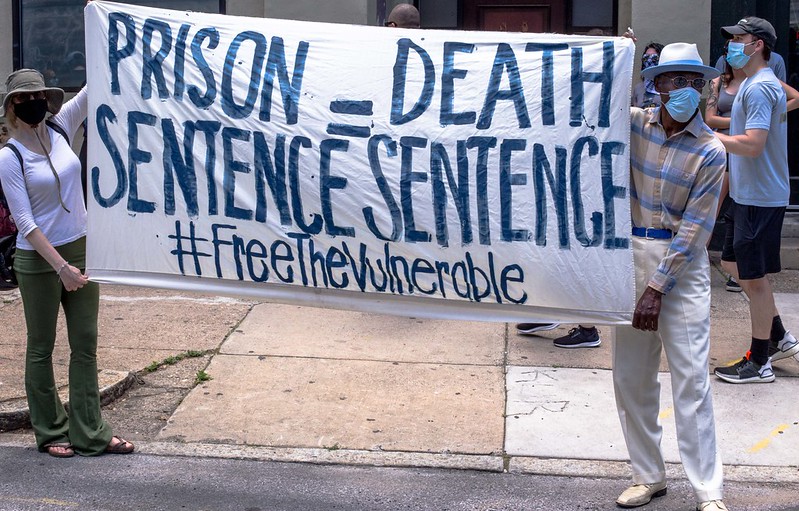
Protesters in Philadelphia demand decarceration during the COVID-19 pandemic. Photo by Joe Piette, shared under Creative Commons https://creativecommons.org/licenses/by-nc-sa/2.0/

by Yosef Robele

Editor’s note: With this thoroughly researched academic article, Prison Health News has the rare privilege of offering scientific data—in addition to our continuing testimonies from people in prison—about how the COVID-19 pandemic has impacted incarcerated people. We agree with the author, Yosef Robele, that decarceration is the winning strategy we all must fight for.  

Yosef is a 2nd year masters student in the Environmental Health Science & Policy Track at George Washington University School of Public Health. He was born and raised in Denver, Colorado. He went to undergrad at the University of Pennsylvania, where he majored in Environmental Science and minored in Physics. He hopes to have a career tackling environmental justice issues from a scientifically informed background.

Abstract

The COVID-19 pandemic has done much to reveal structural inequalities in American society. Throughout the pandemic, the Prison Industrial Complex has been shown to be wholly inadequate in protecting incarcerated persons, prison staff and the surrounding communities. As both the incarcerated persons and the staffs have higher rates of chronic disease than the general population (Wildeman & Wang, 2017), this places them at higher risk of an adverse outcome from contracting COVID-19. While the prison population has actually decreased by about 10% for various reasons during the pandemic, (Franco-Paredes et al., 2021) prison reform advocates have called for more radical slashes. This paper will advocate not only for these radical slashes but also for other forms of support for formerly incarcerated people. Over summer 2020 alone, over 500,000 cases of COVID-19 can be attributed to the carceral state (Hooks & Sawyer, 2020). In order to prevent further cases and deaths, it’s imperative that incarcerated people are not only released but released with enough health care and housing to support themselves during the pandemic.

Continue reading Prison Decarceration in the Context of the COVID-19 Pandemic  

Prison Health News Advisory Board Member Under Threat for Health Activism in Oregon Prison

April 28, 2022

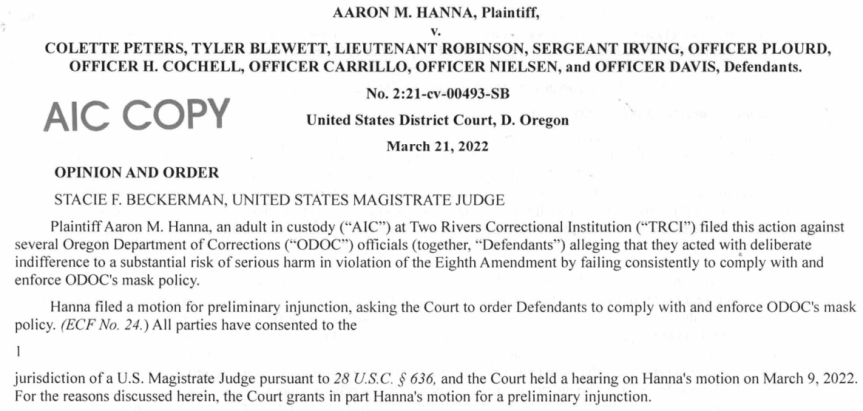
One of our beloved Advisory Board members for Prison Health News, Aaron Maxwell Hanna, filed a lawsuit last year against the Oregon Department of Corrections for not enforcing its own rule that prison employees must wear a face mask to protect those inside the prisons from COVID-19. It’s widely known that prison guards are the most common way COVID gets into prisons from the community. After filing the lawsuit, Max got COVID earlier this year. At his facility, Two Rivers Correctional Institution, 1,287 others have contracted COVID; across the state, 45 people in prison have died of it.

Due to his tireless advocacy, Max won a preliminary injunction on March 21 in federal court that requires the prison authorities to enforce their own mandate for staff to wear face masks. After Max won the injunction, guards allegedly pressured a gang member to take Max’s life, but Max was able to use the support he has from other prisoners to reach this gang member, who is now testifying for Max. We are awaiting the next court hearing, which will be May 10 and cover the alleged retaliation by prison guards against Max and others.

Max requested that we share this note from him on our website, along with a copy of the preliminary injunction:

I am fighting the good fight and standing up against an entire prison staffed with right-wing Republicans who don’t care about me or anyone serving a sentence behind these walls. You have no idea how big, how red and bright this target is on my back, but I don’t care because I am doing the right thing for everyone! This is what matters to me, and how I want to be remembered.

With what I am writing to you, I hope to encourage all of you who are prison activists, who want to protect the lives of those that can’t or won’t stand up for themselves. Please keep all of us in your thoughts and prayers. If you want to email me with words of encouragement, please do so at: MaxwellH7019@gmail.com and I’ll get those from you. I’ll even respond to you if you let me know that you want me to do so.

Stay strong, brothers and sisters!
Max

You can read the preliminary injunction here: https://prisonhealth.news/wp-content/uploads/2022/04/max-hanna-mask-injunction-2022.pdf

COVID Prison Testimonies: Laderic McDonald in Missouri, August 2020

August 31, 2020
Laderic McDonald
Potosi Correctional Center, Missouri

This is Laderic McDonald and I am writing you to ask you to advocate on the behalf of me and other offenders at PCC.

We currently do not have any Dial soap or any anti-bacterial soap at canteen when we placed our Ad-Seg canteen orders. We are only allowed 2 bars per month per policy, so if you attempted to order Dial soap, you may not have gotten any soap at all. How can we keep our hands clean? How can we sanitize our cells? They do not allow us to clean our cells, a Big Health Hazard! We have no soap and COVID-19 is still pummeling America. Please call Potosi Deputy Warden of Ops, Jody Glore and advocate on our behalf. Tell him we need to be afforded access to cleaning/hygiene supplies that will keep us CORONA FREE.

Guards are not wearing a mask in Ad-Seg. They have to feed us, escort us to medical, showers, rec cages, phones and etc, but they are not wearing a mask, and they cannot practice social distancing.

It would be nice if they released offenders with no conduct violations out of Ad-Seg so we can take care of ourselves. Ad-Seg is unsafe and has offenders at risk for COVID-19. Not a good situation!

Please do something. We need your help.

With all due respect,

Laderic

Editor’s note: Ad-Seg is a term for solitary confinement. Prison Health News did respond to this letter when we received it, and we sent some information about how to advocate for oneself using grievances, lawsuits and other means.

Saving Your Mind: Mental Health in the Age of COVID

By Leo Cardez
November 1, 2020
Illinois Department of Corrections

“This is some crazy ass shit; and I thought I’d seen it all after twenty years in the joint.”  Murder*, my COVID wing co-worker, lamented while shaking his head.  We were dragging yet another fellow inmate to the hospital wing of our prison.  Murder is a seasoned con from the streets of Chicago’s South side, but I swear I saw a tear in his eye.

            There were four of us glorified janitors working in the makeshift quarantine wing of our prison.  Besides cleaning, we were tasked with moving and caring for sick (even dead) inmates.  At the peak of our coronavirus outbreak, we worked seven days a week double shifts, sweating through our full PPE—too busy to even stop and eat.  It was only at the end of the day, during my shower, that I would finally have a moment to catch my breath.  Sometimes I would break down, hiding my tears as the warm water washed over me.  My co-workers and I suffered everything from nightmares to migraines.  We lost and gained weight at an alarming rate.  We slept sporadically and were often depressed or angry.  Double D, my morning co-worker, said it best, “We are never going to be the same after this… you cannot unsee or undo this type of damage.”

Continue reading “Saving Your Mind: Mental Health in the Age of COVID”