A Tool in the Struggle to End Medical Copays

By PHN Editors
From PHN Issue 50, Summer/Fall 2022

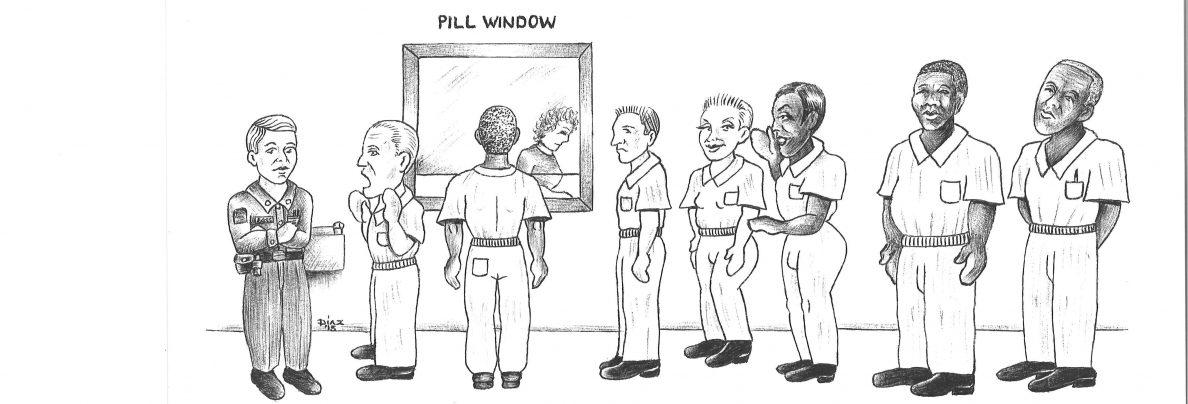
Activists in Pennsylvania have started a coalition to end the $5 copay for medical care in state prisons. The coalition includes FAMM, the Pennsylvania Prison Society, the Coalition to Abolish Death By Incarceration (CADBI), the Institutional Law Project, and Physicians for Criminal Justice Reform—and now Prison Health News has joined too. For those in prison in Pennsylvania, you can help! We need to show the DOC that the copays are truly a hardship for incarcerated people and their families. To do that, you can start using the grievance process when you are unable to afford a copay. The DOC tracks grievances, so seeing grievances over copays will help them understand how often people in prison can’t pay. If you’re not in Pennsylvania, you can do this too, but there is more power in numbers where there is a group of activists taking action together.

Continue reading “A Tool in the Struggle to End Medical Copays”

COVID-19 Updates: JULY 2022

By Lily H-A
From PHN Issue 50, Summer/Fall 2022

Omicron and BA.5

The current version of the coronavirus that is infecting the most people in the U.S. is called BA.5. This is a “sub-variant” of the omicron variant. It is the most contagious version of the virus yet, and it’s sometimes able to get past antibodies from prior infections and vaccination. However, these antibodies do still provide some protection from BA.5, especially against severe illness and death. BA.5 does not seem to cause more severe disease than other variants. Data are also beginning to suggest that long COVID may be somewhat less common for people after being infected with omicron sub-variants than with earlier variants.

Continue reading “COVID-19 Updates: JULY 2022”

An Open Letter to the Incarcerated of Pennsylvania

By Anonymous
June 16, 2022

It has been more than a year since the Pennsylvania Department of Corrections vaccinated its inmate population. Mask mandates have been lifted. The unvaccinated have been allowed off quarantine and spread throughout general population. And yet here we are, another year gone, and the pandemic restrictions limiting activity and quality of life within the prisons remain. The PADOC has successfully used a deadly pandemic as a smoke screen to institute many of the wide-ranging and destructive restrictions it’s wanted all along.

Many of us served as “essential” workers during the pandemic, tirelessly disinfecting the blocks, preparing food and distributing trays. We toiled for long hours to keep the prisons running, with the understanding that Covid was an unprecedented situation that required all of us to work together. Besides those few lucky enough to work, the majority of us were stuck confined in our cells for days and weeks and months on end. It was tough on all of us, but we made it through, and to show its appreciation for our cooperation the PADOC has chosen to keep its pandemic restrictions in place indefinitely.

Continue reading “An Open Letter to the Incarcerated of Pennsylvania”

Ask PHN: Reducing Your Risk of Diabetes in Prison

By Lisa Horwitz and Seth Lamming
From PHN Issue 49, Spring 2022

Question:
Dear Prison Health News,
How do I avoid diabetes when the meals usually consist of white bread, white rice, cake, cornbread, fruit served in syrup, and white noodles? I would appreciate any information you can provide. Thank you.

— Colin Broughton, South Carolina

Answer:
Thanks for this great question! Type 2 diabetes, also known as adult onset diabetes (high blood sugar), is a common long-term health problem that affects 1 out of every 10 Americans. It can cause many physical complications, and of course we would all like to prevent getting it if at all possible (If you have diabetes, PHN has written a “Diabetes Self-education Guidebook” that we will send you on request).

Continue reading “Ask PHN: Reducing Your Risk of Diabetes in Prison”

High Blood Pressure (Hypertension) And What You Can Do About It

By Lucy Gleysteen and Seth Lamming
From PHN Issue 49, Spring 2022

Whenever your heart beats, it pushes blood through your body to nourish tissues and organs. The heart has to beat with enough force to reach every part of the body. However, many people have blood pressure that is too high. When blood vessels are narrowed by conditions such as high cholesterol, the heart has to work harder to supply blood to the rest of the body, increasing pressure. High blood pressure, also known as hypertension, over time causes less blood flow to the kidneys, which causes the body to retain more water and salts. With more water and salts in the body, the heart has to beat harder to manage all the fluid, causing an increase in blood pressure.

What is blood pressure, and what do the numbers mean?

Blood pressure is the measurement of how much pressure or force there is of blood pushing up against the walls of your arteries. Arteries are what carry blood from your heart to other parts of your body.

Blood pressure readings have two numbers. Systolic, the number on top, represents the pressure on blood vessel walls when your heart is beating or contracting. Diastolic is the number below, and it represents the pressure on your blood vessels between beats when your heart is relaxing. It is normal for blood pressure to fluctuate over the day.

Continue reading “High Blood Pressure (Hypertension) And What You Can Do About It”

What You Need to Know About Your Rights of Consent Regarding Medical Care

By C. Nunley, GRCC, KY

Do you know what “consent” means? Maybe you think that you might, or perhaps you know what the dictionary defines it as, but did you know that legally, as far as the healthcare system goes, there are two basic types of consent?

The first type of consent is known as “implied consent.” This type of consent is typically based on actions rather than words. One example of implied consent is in emergencies. If you are found unconscious and not breathing, the law basically says that a reasonable person would assume you want them to save your life, so consent is implied without you having to say anything.

Continue reading “What You Need to Know About Your Rights of Consent Regarding Medical Care”

MDOC Covid-19 ‘Quarantine’ Reaps Financial Windfall for Corizon Health’s Investors

By Rand. W Gould, October 2021

Reprinted with permission from San Francisco Bay View National Black Newspaper

In early March 2020, the Michigan Department of Corrections (MDOC) declared a so-called “medical quarantine” for influenza, i.e., the flu, that quickly morphed into the COVID-19 “quarantine” still in effect to this day. Just as quickly, MDOC health care provider Corizon Health, Inc., took full advantage of this quarantine to deny prisoners constitutionally mandated health care across the board, including dental, optical, hepatitis B and other vaccines, with all previously scheduled 2020 medical consults and surgeries canceled.

Continue reading “MDOC Covid-19 ‘Quarantine’ Reaps Financial Windfall for Corizon Health’s Investors”

Covid-19 Updates: April 2022

By Lily H-A

The most recent wave of COVID-19 cases, driven by the omicron variant of the coronavirus, peaked in January in the US. The rate of COVID-19 cases at that point was by far the highest in the US to date. Cases dropped rapidly over the next couple months. However, as of April 2022, cases have begun to rise again in many parts of the country, though less steeply than before. This is likely due to a “sub-variant” or slightly different version of the omicron variant called BA.2 (the version of omicron that caused the earlier, larger wave was called BA.1). BA.2 seems to be slightly more contagious than BA.1, but does not seem to be more severe.

Continue reading “Covid-19 Updates: April 2022”

Convict Chronicles: Tip #21: Breathe Easy

By Leo Cardez

Adapted from Yoga Magazine 2020, Pam O’Brien

There is a medical term called heart rate variability, or HRV, which stands for the variability of time between heartbeats. There’s significant research demonstrating a correlation between better HRV (more variety in the length of time from one heartbeat to the next) and improved mood, enhanced focus, better sleep, boosted energy, and more resilience overall. Anyone would benefit from better HRV—and fortunately, anyone can … with a little practice.

Continue reading “Convict Chronicles: Tip #21: Breathe Easy”

Indiana Begins to Allow Hormone Therapy Treatment for Transgender Inmates

By Tonie. N Loveday

I would like to relay my story of how I, a transgender woman and inmate doing time at the Indiana State Prison in Michigan City, took on the Indiana Department of Correction (IDOC).

Not being on hormone treatment prior to incarceration, the IDOC would not allow transgender inmates to begin them. I was not diagnosed with gender dysphoria until June 2015, seven years into my sentence. Gender dysphoria is the medical diagnosis for experiences of distress and discomfort connected to a difference between one’s gender identity and their sex assigned at birth. Diagnosis by a psychologist, psychiatrist, or doctor is often required to receive gender-affirming care, such as hormone therapy and gender-affirming surgeries. A diagnosis of gender dysphoria is not needed to identify as transgender or be a part of the community. However, it is often needed to access treatment.

Continue reading “Indiana Begins to Allow Hormone Therapy Treatment for Transgender Inmates”