Fight For Your Medical Rights!

By Brother W. (Uthman) Williams

From PHN Issue 28, Spring 2016

The New York State prison health care system has been broken for a long time now. In 1977, women incarcerated in New York brought civil rights claims challenging medical care. Chief Judge Kaufman responded: “The sad often desperate plight of many incarcerated in our nation’s prisons is most dramatically revealed by the all too frequent petitions of inmates who have been denied access to basic medical services.” Continue reading “Fight For Your Medical Rights!”

Accessing Gender-Affirming Health Care in Prison

by Mrs. Ge Ge

From PHN Issue 28, Spring 2016

Hello friends,

My name is Mrs. Ge Ge. I am a trans woman incarcerated in PA. I am also the founder of an LGBT+ (lesbian, gay, bisexual and transgender–plus) organization called L.I.G.H.T. We aim to educate readers about DOC policies that protect them, laws, health and politics. We use this information to strengthen our ability to fight the prison industrial complex, by using its own policies against it. I am writing simply to spread some knowledge on how to get gender affirming health care in prison. There are several useful tools you can use to accomplish this. I will list some addresses at the end of this article. Continue reading “Accessing Gender-Affirming Health Care in Prison”

Knowledge Is Power

by Michael Rigby

From PHN Issue 26, Fall 2015

True indeed—knowledge is power—but only to those who use it. The most powerful tool a prisoner has in the fight to maintain health is the pen. Unless it’s a life and death situation or an all-out emergency, the very first thing you should do when you begin to notice changes within your temple (body) is take note.

How to keep your own health records:

Headline a fresh sheet of paper with “Time,” “Date,” and “Notes.” Continue reading “Knowledge Is Power”

Fight for Health Justice in Womanhood

by Fatima Malika Shabazz

From PHN Issue 26, Fall 2015

Dear Reader,

My name is Fatima Malika Shabazz. Some of you may be familiar with my name through a previous article I wrote. I want to thank all of you who in one way or another have reached out to a trans woman or trans man in any prison in America. I am currently doing time in the California prison system. In a state that is supposed to be very progressive in regard to LGBTQ rights, it would appear that the secretary of prisons has not gotten that memo. Continue reading “Fight for Health Justice in Womanhood”

Battling Asthma in Prison

By Gregory J. Marcinski, EMT-P (ret)

From PHN Issue 26, Fall 2015

If you’re suffering from asthma, you’re not alone. More than 18 million American adults have asthma, and thousands go to the emergency room every day because of it. In prison, it can be a bit more difficult to be seen by medical staff, so I’ll discuss a few things that we can do on our own to help preserve our own health. Continue reading “Battling Asthma in Prison”

How Loved Ones Outside Can Advocate for People in Prison


By Theresa Shoatz

From PHN Issue 25, Summer 2015

For readers who have family, friends or a partner on the outside to help them get urgently needed health care, here are some suggestions for those outside prison to try. Philadelphia activist Theresa Shoatz perfected these steps while advocating for her father, former Black Panther Russell Maroon Shoatz, a political prisoner in Pennsylvania. As she says, “I have a passion to keep him healthy because one day, we’ll get him out.”

10 steps for loved ones on the outside:

  1. Your loved one in prison will probably need to fill out a medical release form to let you access their health information. In many places, they can ask a counselor for this form. Continue reading “How Loved Ones Outside Can Advocate for People in Prison”

The Lasting Impact of Brain Injury

by Drew Nagele, MJ Schmidt, and Monica Vaccaro
From PHN Issue 21, Summer 2014

Each year, there are 2.5 million new traumatic brain injuries in the United States. In fact, it is estimated that 13.5 million people—or 4.5% of the population—are living with some type of acquired brain injury.
The number of people who are living with a brain injury in prisons is far greater than we would expect, and most of these injuries were never diagnosed or treated. Recent research suggests that about 60% of people in prison have had an acquired brain injury sometime in their life, most often prior to becoming incarcerated. This is important, because the problems that result from a brain injury make almost all aspects of life harder. Brain injury can make a person more likely to make poor decisions, increasing their risk for getting in trouble with the law and decreasing their likelihood of being successful in everyday life. The effects of brain injuries also can make it harder for a person to succeed in prison education programs or to meet parole conditions.

Continue reading “The Lasting Impact of Brain Injury”

Getting Out Alive

By Teresa Sullivan

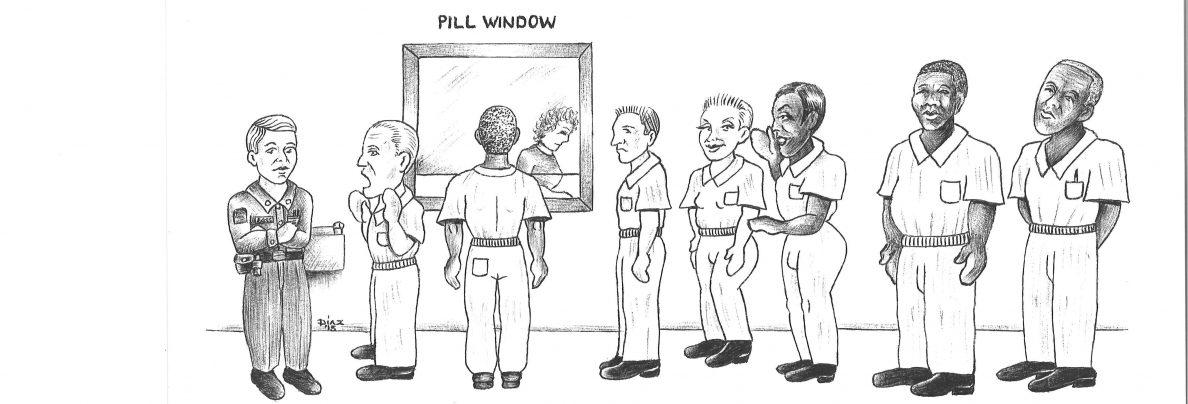
When I went to jail in 2005, one of the biggest problems that I had was at the medication window. One day going to get my HIV medications at the window, I looked at the meds in the cup and they were the wrong meds. There was one too many of the same meds for my HIV medications, and one med I never saw before. This was a big problem because I know that taking the wrong dose of my meds would make me sick – and that med that I never saw before in the cup was not the medication that the doctor ordered for me.

Being told if I did not take the medication in the cup that I would have to go to the hole – that made me very scared, and so I took the medications. Let me say, if I knew what I know today I would have never done that stupid thing, because I got so sick that they had to take me to the ER and I could have died. It is important to know your rights about taking medication while in jail. Today I am an advocate for people that have HIV/AIDS and are in the county jails system. I will never let this happen to someone again while they are in the county jails system. I will always make sure that they know their rights about taking their medications while in jail, and when they are about to come home, I will continue to advocate for their needs.

Continue reading “Getting Out Alive”

Hearts on a Wire

By Najee Gibson

A lot of inmates from the lesbian, gay, bisexual, and transgender (LGBT) community feel lonely because either their families gave up hope for them, or they’re so caught up in the system that they feel like there’s no hope for them when they come out. So they stay back in the same addictive behaviors when they come out, which is not healthy for someone living with HIV.

I did 5 ½ years. I heard about Hearts on a Wire like 2 months before I got released from prison. They were doing an anonymous questionnaire for members of the LGBT community in state facilities: Were you getting health care? How were you being treated? I took the survey and informed them that I was going to be released in April. So they opened their arms and told me to come into the office. That’s how I got plugged in, and from there, things started to blossom. I liked what I heard. All of us need to be understood and cared for, and someone to identify with our hurt. Hearts on a Wire could identify with my hurt, and the bullshit that I put up with being incarcerated, being a person of color – the no-nos, the punishments.

Hearts on a Wire is about 2 years old. We cater to inmates in state facilities in Pennsylvania. We meet every Wednesday, and you pass on what was given to you. We make cards that say, “Keep your head up,” and send them to inmates.

Continue reading “Hearts on a Wire”