
Second issue of Turn It Up! prison health magazine now available

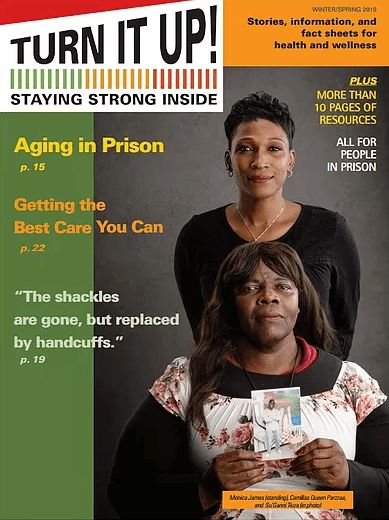
Our sister publication, Turn It Up! Staying Strong Inside, has just released its second issue! This is a beautiful, detailed and comprehensive resource for people in prison about how to survive, thrive and advocate for their health. Turn It Up! is published by the SERO Project.

You can read it online here and order a copy for your loved one in prison here.

Visit TheBody for a wonderful interview with the editors.

Advocating for Yourself in a Medical Setting

By Teresa Sullivan

From PHN Issue 38, Fall 2018

Principles:

  • You have a right to information.
  • You have a right to be treated with dignity and respect.
  • You are entitled to a good relationship with your doctor or health care provider.
  • You have a right to make decisions that affect your health care and your life.
  • You have a responsibility to be effective.
  • You will be more effective if you have a strategy and a plan. Continue reading “Advocating for Yourself in a Medical Setting”

Quick Tips for Common Ailments

By Timothy Hinkhouse

From PHN Issue 38, Fall 2018

Migraines:

Don’t you just hate it when your day hits a brick wall because you feel a blinding migraine coming on? Some people, it practically debilitates them and leaves them curled up in the fetal position in a dark room on their bed with a cool wet cloth on their forehead while wishing for any immediate relief. Continue reading “Quick Tips for Common Ailments”

Colorectal Cancer Occurring Earlier

by Darrell L. Taylor

From PHN Issue 34, Fall 2017

In the New York State Department of Corrections and Community Supervision (DOCCS), inmates are not screened for colorectal cancer until the age of 50, regardless of what ethnic group one may belong to. It has been established that people of African origin are at higher risk than other ethnic groups and therefore should be screened at an earlier age, especially if there is a family history. Finding and removing polyps on the inner wall of the colon or rectum can prevent colorectal cancer. Continue reading “Colorectal Cancer Occurring Earlier”

Breast Health and Screening Mammograms

by Erin Tully and PHN staff

From PHN Issue 34, Fall 2017

            Breast Cancer is the most common cancer in the United States. While breast cancer is most likely to affect cisgender women, it affects people of all genders. (Cisgender means people whose gender identity matches the sex that they were assigned at birth.) Mammograms are recommended for people over the age of 40 who have breasts. Continue reading “Breast Health and Screening Mammograms”

Aging in Prison

by the Gray Panthers, Pennsylvania State Correctional Institution Graterford chapter

From PHN Issue 27, Winter 2016

Elderly people are now 12% of Pennsylvania’s prison population. The number of people 50 years of age or older in Graterford prison alone has increased to 25% of its total population, and the state’s hospice care facility was expanded. The Department of Corrections’ definition of elderly is those over age 50, for good reason. Prison culture stressors and lack of access to holistic healthcare cause “physiological aging” that could mean aging arrives up to 15 years sooner for people in prison. Prison age 50 is the new age 65! Continue reading “Aging in Prison”

Free the Elders, Improve Public Health

by Laura Whitehorn

From PHN Issue 19, Winter 2014

Mohaman Koti is either 85 or 87 years old, depending on whether you go by his birth certificate or what his mother told him when he was a child. He has been incarcerated in New York State since 1978—long enough that his sentencing transcript has been lost in the system.

Mr. Koti has been hospitalized multiple times for health problems, including myasthenia gravis (a neurological disorder) and cancer. He must often use a wheelchair, and his hearing is pretty much shot.

In May, Mr. Koti appeared before the parole board for the sixth time, and was again denied release. The board said they thought he might commit another crime if released—despite testimony from prison staff calling him a reliable peacemaker. Continue reading “Free the Elders, Improve Public Health”