
By Frankie Snow
From PHN Issue 51, Winter 2023
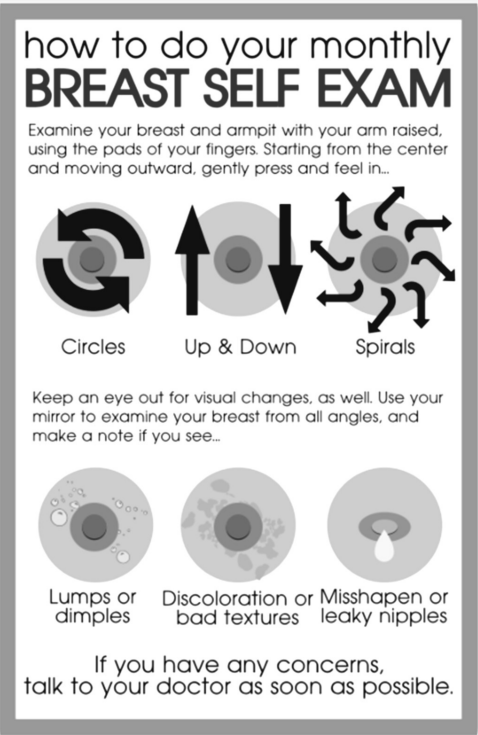
It can be helpful to know the look and feel of your breasts so you are aware when changes occur. If you notice lumps, pain, or changes in size, talk with your doctor about further testing. Try to complete a self-exam once a month, usually seven days after the start of your period, or on the same date each month if you do not menstruate.
Steps to a self-exam:
- While standing, check that your skin does not dimple or pucker when you raise
your arms. - While lying down, use the middle three fingers of your opposite hand to feel
your breast. Move your fingers in a circular, up-and-down, or pinwheel motion
out from the center. - Note any changes in feeling, such as hardness, lumps, pain, or color.
- Gently squeeze the nipple to check for discharge or bleeding.
- Talk to your doctor about any changes you observe.
Certain age groups are also encouraged to get professional screenings. If you don’t have symptoms, it can still be helpful to have regular screenings in order to detect cancer early when it is more treatable.
No Family Cancer History = Screen every two years from ages 50 to 74:
The US Preventive Services Task Force recommends that women who are 50 to 74 years old and are at average risk for breast cancer get a mammogram every two years.
Individuals with History of Cancer in Family and Those on Hormone Treatment:
Women who are 40 to 49 years old should talk to their doctor or other health care professional about when to start and how often to get a mammogram. Women with a family history of breast cancer may need to start screenings at this age.
Transgender men and nonbinary people who have had top surgery may have a reduced risk of breast cancer, but a higher risk than cis men. For this reason, it is important to complete the recommended screenings, regardless of use of testosterone therapy. Transgender women and nonbinary people who take estrogen or other hormone therapy have a lower risk of breast cancer than cis women, but have a higher risk than men. For this reason, it is also recommended to complete screenings. Cisgender men, or those raised as men, can also have cases of breast cancer. Consider screenings if either parent has the genetic mutations listed below.
Individuals with Genetic Risks:
Some people have a higher risk for breast cancer based on specific genes passed from either or both parents. Everyone has a gene called BRCA1 and BRCA2. Some people have gene mutations on BRCA1 or BRCA2 that can increase risk for cancer. For example, if one parent has a BRCA1 gene mutation, there’s a 50% chance you will also have a BRCA1 mutation. It’s estimated that 5% to 10% of breast cancer cases in women are due to gene mutations. Men with BRCA gene mutation have a much higher risk of developing breast cancer. Individuals of Ashkenazi ancestry have a higher risk for carrying BRCA1/2 mutations. If you have a biological family member with breast cancer, ask them if they were tested for BRCA1 and BRCA2 and share this information with your doctor.
Mammograms, MRIs, and Ultrasounds:
During a primary care or reproductive health visit, your healthcare provider may complete a clinical breast exam to feel for any changes in your breast tissue. Your doctor can recommend the most appropriate test for you. A mammogram is a type of x-ray of breast tissue commonly used to look for breast cancer. In some circumstances, an MRI may be completed if an individual is at a higher risk for cancer. Because abnormalities may show up on an MRI but not be dangerous, an MRI is not used when there is only an average risk. Individuals with less breast tissue due to breast reductions, top surgery, or cis men with limited tissue may have an ultrasound instead. A handheld device will be used by your doctor or ultrasound technician to view the tissue for abnormalities.
 Prison Health News